
By the LetsFinancialFreedom Team | Updated November 2026
Imagine waking up on a weekday with no alarm, no commute, and no one else deciding how you spend your time. For most people, that picture is something to enjoy at 65. For a growing number of Americans, it’s a goal they’re working toward in their 40s, or even their 30s.
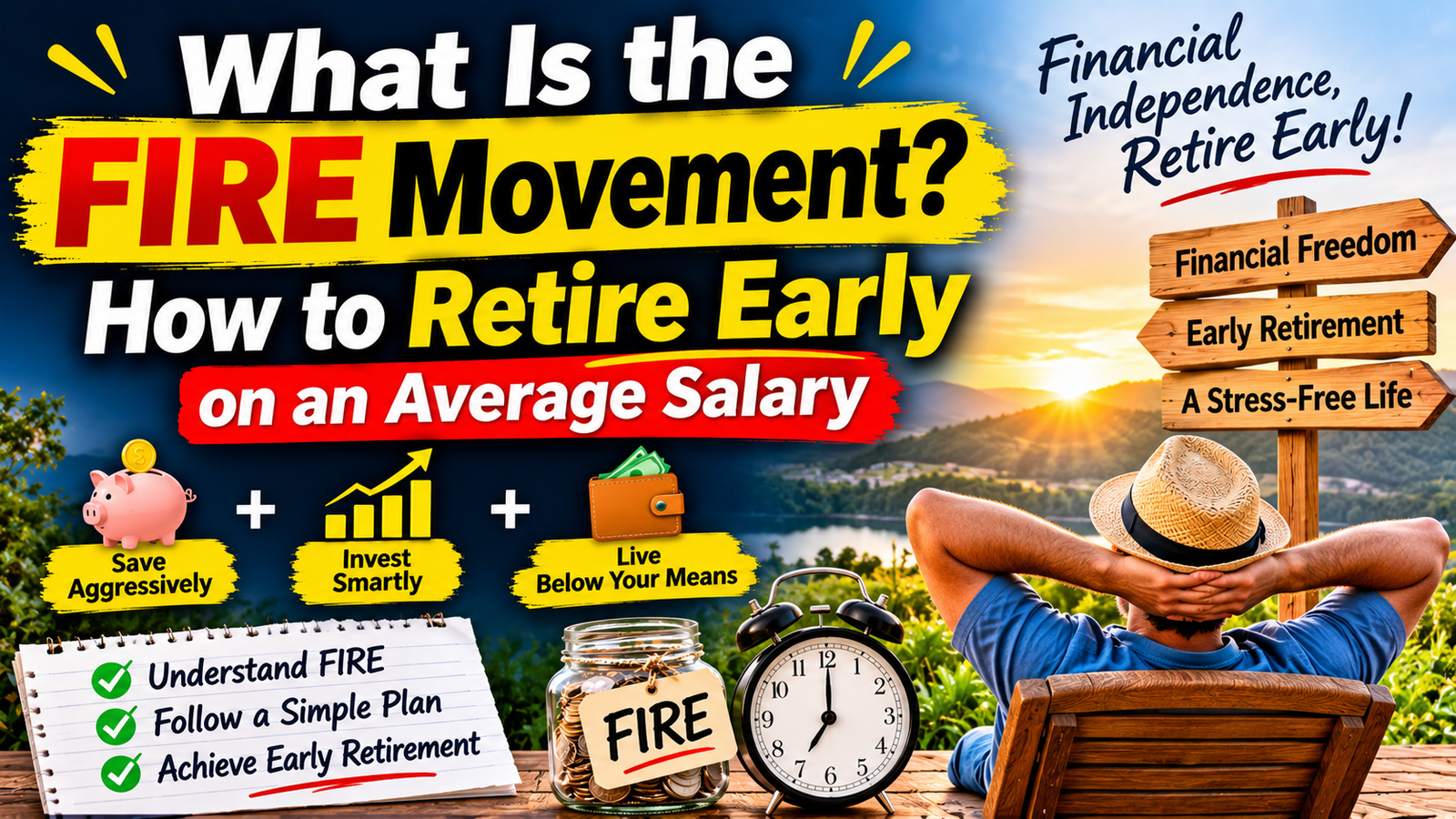
They are part of the FIRE movement, short for Financial Independence, Retire Early. And despite what the headlines suggest, you don’t need a six-figure tech salary to join. You need a high savings rate, a clear number, and a plan.
In this guide, I’ll explain what FIRE is, how the math works, the different flavors of FIRE, how to actually do it on an average income, and the risks that enthusiasts sometimes gloss over, such as healthcare costs and withdrawal rates. Let’s dig in.
What Does FIRE Mean?
FIRE is a lifestyle and financial strategy built on two ideas:
- Save aggressively, often 40% to 70% of your income.
- Invest those savings, usually in low-cost index funds, until your portfolio can cover your living expenses indefinitely.
The first word matters most: financial independence. That’s the point at which your investments generate enough to pay for your life, so work becomes optional. “Retire early” doesn’t necessarily mean never working again. Many people in the FIRE community leave their careers and then pursue a passion project, a part-time job, or a business, simply because they want to rather than because they have to.
The Math Behind FIRE
FIRE rests on a surprisingly simple calculation.
Step 1: Know Your Annual Expenses
Add up everything you spend in a year: housing, food, transportation, healthcare, insurance, travel, fun. Be honest. Your expenses drive the entire plan.
Step 2: Calculate Your FIRE Number
A common shortcut is the 25x rule: multiply your annual expenses by 25. This comes from the 4% rule, the idea that you can withdraw 4% of your portfolio in the first year of retirement, adjust that amount for inflation each year, and have a good chance of your money lasting 30 years.
| Annual spending | FIRE number (25x) |
|---|---|
| $30,000 | $750,000 |
| $40,000 | $1,000,000 |
| $50,000 | $1,250,000 |
| $60,000 | $1,500,000 |
The key insight: every $1 of spending you cut reduces your target by $25. That’s why FIRE followers obsess over expenses. Cutting $200 a month from your budget lowers your goal by $60,000.
Is the 4% Rule Still Safe?
This is the part of FIRE that deserves caution. The 4% rule was built around a 30-year retirement, while someone retiring at 40 may need their money to last 50 years or more. Research also changes with market conditions. Morningstar’s annual analysis, for example, recommended <cite index=”135-1″>a starting withdrawal rate of 3.9% for people retiring in 2026</cite>, a bit below the traditional 4%.
Because early retirees face longer time horizons, many in the FIRE community plan around 3.25% to 3.5% instead. That raises the target:
| Annual spending | At 4% (25x) | At 3.5% (about 28.6x) |
|---|---|---|
| $40,000 | $1,000,000 | About $1,143,000 |
| $50,000 | $1,250,000 | About $1,429,000 |
Treat the 4% rule as a starting point, not a guarantee. A safer approach is to build in a margin of safety and stay flexible with spending when markets drop.
Your Savings Rate Is the Real Engine
Here is the most powerful idea in FIRE: how long it takes to reach financial independence depends mostly on your savings rate, not your income. A high earner who spends everything may never get there, while an average earner who saves aggressively can.
The table below shows the approximate number of years to reach FIRE starting from zero, assuming a 5% average annual return after inflation and a 4% withdrawal target. These are simplified illustrations, not predictions.
| Savings rate | Years to financial independence |
|---|---|
| 10% | About 51 years |
| 20% | About 37 years |
| 30% | About 28 years |
| 40% | About 22 years |
| 50% | About 17 years |
| 60% | About 12 years |
| 70% | About 9 years |
Moving your savings rate from 20% to 50% cuts your timeline by about 20 years. That is why people who pursue FIRE focus so intensely on both lowering expenses and raising income.
A Realistic Example on an Average Salary
Let’s make this concrete. Meet Jordan, a single worker with a take-home pay of $4,500 a month ($54,000 a year).
- Jordan spends $2,700 a month ($32,400 a year) on rent with a roommate, groceries, a used car, and a modest social life.
- Jordan saves $1,800 a month ($21,600 a year), which is a 40% savings rate.
- FIRE number at 4%: $32,400 x 25 = $810,000.
- At 3.5%, the safer target: about $926,000.
Using the same assumptions as above (5% real returns), Jordan would reach $810,000 in about 22 years, or about 23 to 24 years for the more conservative target. Retiring at 25 would mean financial independence around 47 to 49. Not exactly “retire at 30,” but still more than 15 years ahead of the traditional timeline.
Now imagine Jordan finds ways to raise the savings rate to 55% by earning more through a raise or side income and trimming expenses. The timeline drops to roughly 15 years. Small shifts in savings rate create big shifts in freedom.
The Different Flavors of FIRE
Not everyone wants the same version of early retirement. The community has several variations:
Lean FIRE. Living on a minimal budget, often under $40,000 a year, with a smaller portfolio. It requires strong frugality and a low cost of living.
Fat FIRE. A more comfortable lifestyle, often $100,000 or more per year, which requires a much larger portfolio and typically a high income.
Barista FIRE. Leaving full-time work for part-time or flexible work, such as a job at a coffee shop, which covers part of your expenses and often includes health benefits. Your portfolio only has to cover the gap.
Coast FIRE. Saving enough early that your investments will grow to a full retirement fund by traditional retirement age without any more contributions. After that, you only need to earn enough to cover current expenses.
Slow FIRE. Making steady progress while still enjoying life now, without extreme sacrifices.
For many people on an average salary, Coast FIRE or Barista FIRE are more realistic and less stressful than full early retirement.
How to Reach FIRE on an Average Income
1. Attack Your Biggest Expenses First
Housing, transportation, and food usually make up the majority of spending. Cutting these three is far more effective than skipping lattes. Options include a roommate or house hacking, a cheaper rental, driving a reliable used car for years, and cooking at home.
2. Raise Your Income
There’s a limit to how much you can cut but no limit to how much you can earn. Ask for raises, switch jobs for higher pay, develop in-demand skills, or add a side hustle. Then keep your spending flat, so most of the increase goes toward investments.
3. Invest Simply
Most FIRE followers invest in broad, low-cost index funds. Keeping fees low matters even more over a 20-year or longer horizon. Check out our beginner’s guide to index funds for how to get started.
4. Use Tax-Advantaged Accounts Wisely
Take full advantage of your employer’s 401(k) match, a Roth IRA, and an HSA if eligible, while also building a taxable brokerage account. That last one is important for FIRE, because it gives you penalty-free access to money before age 59½.
5. Avoid Lifestyle Creep
Every raise is a test. If your spending rises as fast as your income, your savings rate never improves.
How to Access Your Money Before Age 59½
This is the question beginners often miss. Most retirement accounts charge a 10% penalty on withdrawals before 59½, so early retirees need strategies to get at their money. Common approaches include:
- Taxable brokerage account. No age restrictions, which is why it is the foundation for many early retirees.
- Roth IRA contributions. You can withdraw what you contributed, though not the earnings, without tax or penalty.
- Roth conversion ladder. Gradually converting pre-tax money to Roth, then withdrawing the converted amounts after a five-year waiting period.
- Rule of 55. Allows penalty-free withdrawals from the 401(k) of the employer you leave in or after the year you turn 55, if your plan allows it.
- 72(t) distributions. A series of substantially equal periodic payments that avoid the penalty but come with strict rules.
These strategies carry tax and rule complexities, so it is wise to consult a tax professional before leaving work.
The Risks FIRE Enthusiasts Don’t Always Talk About
Healthcare Costs
For U.S. early retirees, health insurance can be one of the biggest budget items. Retirees under 65 typically rely on ACA marketplace plans, COBRA, or a spouse’s plan. The picture got tougher recently: <cite index=”149-1″>the enhanced premium tax credits introduced in 2021 expired on December 31, 2025</cite>. Without them, <cite index=”152-1″>the subsidy cliff returns, cutting off premium tax credits for households with income above 400% of the federal poverty level</cite>. That means your withdrawal strategy and how much taxable income you report can directly affect your premiums. Budget generously for healthcare, and recheck current rules before you leave your job.
Sequence-of-Returns Risk
If the market drops sharply in your first few years of retirement while you’re withdrawing, the damage can be much larger than the same drop later. Protect yourself with a cash cushion of one to three years of expenses, flexibility to spend less in bad years, and part-time income if needed.
Inflation
Prices rise over time, and a 40-year retirement gives inflation plenty of room to hurt. A diversified portfolio with significant stock exposure helps, but plan for rising costs.
Lower Social Security Benefits
Social Security is calculated from your highest 35 years of earnings. Retiring at 40 leaves zeros in the formula, which may reduce your future benefit. It likely won’t wreck your plan, but don’t assume a full benefit.
The Emotional Side
Some people reach their number and feel lost. Work gives structure, purpose, and community. Think about how you want to spend your days, not just how you’ll pay for them.
Is FIRE Right for You?
FIRE isn’t for everyone, and that is fine. It tends to work best when you:
- Have a stable income and can save a large share of it
- Are comfortable with a modest lifestyle for years
- Value time and freedom more than status or stuff
- Are willing to stay flexible when markets or life change
It may be harder if you have high-cost dependents, unstable income, or significant debt. Even then, a modified approach, such as saving more than average, targeting Coast FIRE, or aiming to retire at 55 rather than 40, can still improve your future dramatically.
Your First Steps Toward FIRE
- Track your spending for 30 days to find your real annual expenses.
- Calculate your FIRE number, and a safer number at 3.5%.
- Find your current savings rate and set a target for the next year.
- Build your foundation first: a starter emergency fund, and pay off high-interest debt.
- Invest in low-cost index funds, starting with your 401(k) match and a Roth IRA.
- Automate your contributions and increase them with every raise.
- Review annually, and adjust as your goals and life change.
Frequently Asked Questions
How much do I need to retire early? A common starting point is 25 times your annual expenses, or about 28 times if you want a more conservative withdrawal rate. Your own number depends on your spending, healthcare costs, and other income.
Can I do FIRE on an average salary? Yes, but it usually takes a high savings rate and a longer timeline. Lower spending and higher income both help, and lighter versions like Coast or Barista FIRE can be more realistic.
Is the 4% rule reliable for early retirement? It was designed for roughly 30 years, so early retirees often use a lower rate, such as 3.25% to 3.5%, and stay flexible.
What about healthcare before Medicare? Healthcare is one of the largest risks for early retirees in the U.S. Plan for marketplace plans, COBRA, or other coverage, and recheck subsidy rules, since they have changed.
Is FIRE a good idea if I love my job? Possibly. Financial independence gives you options, even if you never fully retire. Many people reach FI and keep working on their own terms.
Final Thoughts
The FIRE movement is really about something bigger than retiring at 40. It’s about buying back your time. Even if you never fully retire early, moving toward financial independence gives you choices: to switch careers, take a break, care for family, or say no to a job that drains you.
You don’t need to be perfect or extreme. Start by learning your numbers, raising your savings rate a little, and investing consistently. Every percentage point you add shortens the road to freedom.
Disclaimer: This article is for educational purposes only and is not financial, investment, tax, or legal advice. Projections are hypothetical and rely on assumptions that may not hold. Withdrawal rates, tax rules, health insurance subsidies, and contribution limits change, and investing involves risk of loss. Consult a qualified financial planner and tax professional before making major decisions such as leaving your job.