
By the LetsFinancialFreedom Team | Updated November 2026
“Passive income” is one of the most overused phrases in personal finance. Scroll online and you will see people promising money that appears while you sleep, with no work, no risk, and no catch. If that were true, everyone would already be doing it.
The real story is more interesting, and more useful. Passive income does exist. But it is almost always the result of either money you invested or work you did upfront. Very little of it is truly “passive” in the beginning, and some of it never is. Understanding that difference will save you time, money, and disappointment.
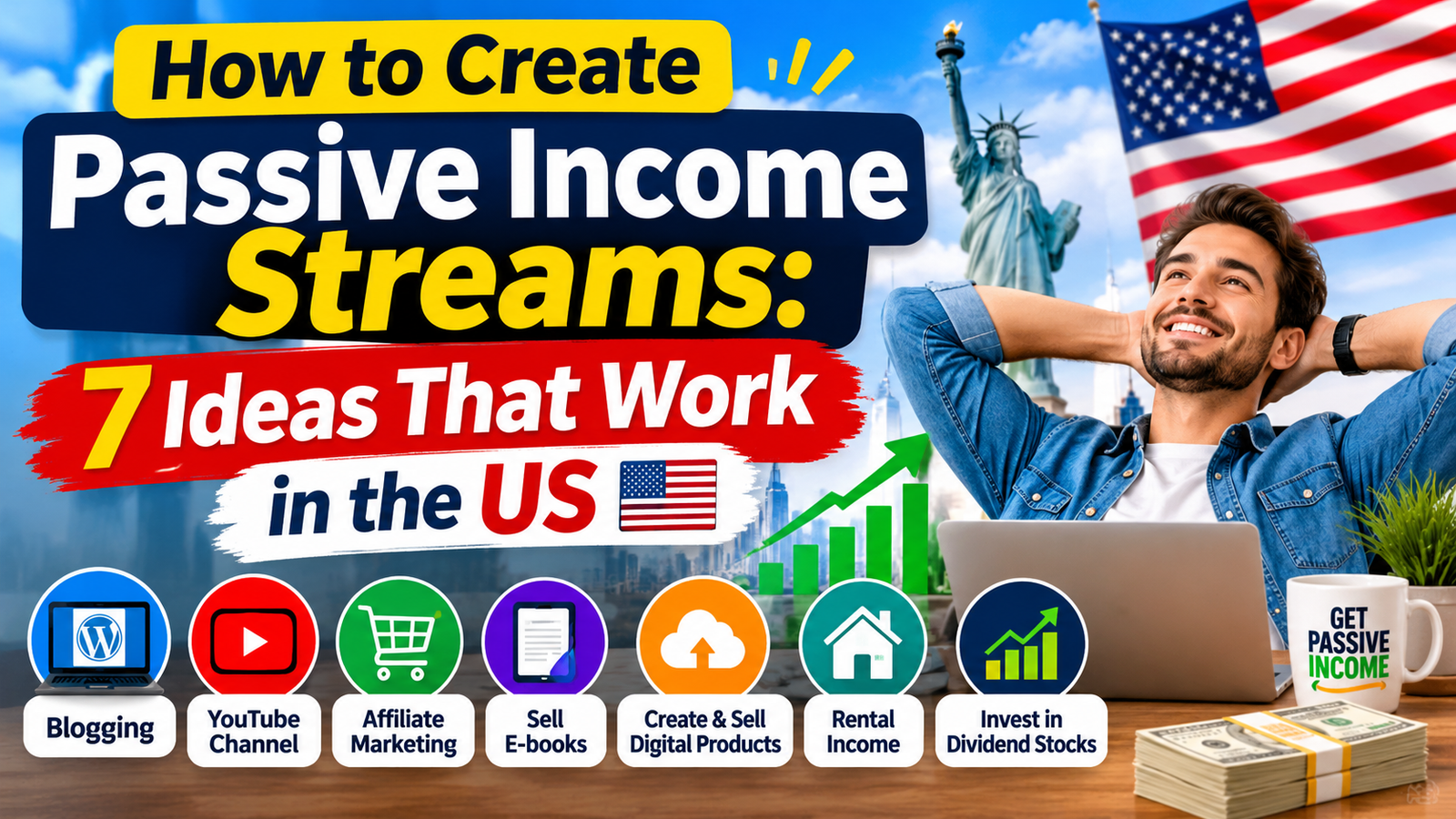
This guide walks through seven legitimate passive income ideas that work in the United States, what each one actually requires, how much you might realistically earn, and the risks and tax issues to know about. By the end, you should be able to pick the one or two that fit your situation and start this month.
What Does “Passive Income” Really Mean?
Passive income is money you earn with little ongoing effort once the income stream is set up. It usually falls into two categories:
- Money-based. You put capital to work, and it earns a return. Examples: savings interest, dividends, rental income. Effort is low, but you need money to start.
- Time-based (build once, earn repeatedly). You invest hours upfront to create an asset, such as a website, a digital product, or a video library, that earns over time. Money required is low, but time and patience are high.
If you have more money than time, lean toward the first category. If you have more time than money, lean toward the second. And remember, the IRS has its own definition of “passive” for tax purposes, which may differ from what feels passive in real life, so don’t assume the tax treatment from the label alone.
A Reality Check on the Numbers
How much do you need to invest to generate $500 a month, or $6,000 a year? It depends heavily on the yield. Here’s the math at different rates:
| Yield on your money | Capital needed for $6,000 a year |
|---|---|
| 1.35% (typical broad-market dividend yield) | About $444,000 |
| 3% | $200,000 |
| 4.7% (top savings rate) | About $128,000 |
This illustrates why many people combine money-based income with time-based income. If you don’t have six figures to invest, building an asset with your time may be the faster route. And as you will see, higher yield almost always comes with higher risk or more effort.
Idea 1: High-Yield Savings Accounts, CDs, and Treasuries
What it is: Lending your money to a bank or the government in exchange for interest.
Why it’s worth knowing: This is the closest thing to truly hands-off income. Rates move with the economy, but recent ones have been attractive. Fortune’s daily rate tracker listed <cite index=”2-1″>high-yield savings rates up to 4.70% APY on November 3, 2026</cite>, while <cite index=”167-1″>the highest-yielding certificates of deposit offered up to 5.05% APY as of November 2, 2026</cite>. Rates shown are top-of-market offers and change frequently, so verify before you act.
Pros: Very low risk (FDIC insurance covers up to $250,000 per depositor, per bank, per ownership category), no effort, and easy access with savings accounts.
Cons: Rates can fall, and interest is taxed as ordinary income. A CD locks your money up for a set term, and returns may not keep pace with inflation over long periods.
Best for: Your emergency fund and short-term savings, rather than long-term wealth building.
Idea 2: Dividend Stocks and Dividend ETFs
What it is: Owning shares of companies that share part of their profits with shareholders, paid out as dividends, usually quarterly.
How it works: You can buy individual dividend-paying stocks or, more simply, a dividend-focused ETF or an index fund. Broad market funds pay modest dividends, since the typical S&P 500 fund yields about 1.35%, <cite index=”95-1″>based on one 2026 comparison of the Vanguard S&P 500 ETF</cite>. Dividend-focused funds often yield more, sometimes in the 3% to 4% range, though higher yields can signal higher risk.
Pros: Genuinely hands-off, potential for growth in both share price and dividends over time, and low minimums thanks to fractional shares.
Cons: Stock prices can fall, dividends can be cut, and chasing the highest yield is a classic trap. Qualified dividends are taxed at lower rates than ordinary income, but in a regular brokerage account you’ll owe tax each year.
Tip: Focus on companies or funds with a history of growing dividends, not just the highest current yield. Reinvesting dividends automatically helps your income snowball. For beginners, our guide to index funds covers how to start with as little as $100.
Idea 3: REITs (Real Estate Investment Trusts)
What it is: Companies that own and operate income-producing real estate, such as apartments, warehouses, cell towers, and shopping centers. By law, REITs generally must distribute most of their taxable income to shareholders.
Why people like them: You get exposure to real estate and its rental income without buying a property, dealing with tenants, or fixing a leaky roof. You can buy REITs or REIT ETFs through any brokerage account, often with a small amount of money.
Pros: Typically higher yields than the broad stock market, easy diversification, and good liquidity compared with owning physical property.
Cons: REIT prices can be volatile and are sensitive to interest rates. Dividends are often taxed as ordinary income, although some investors may qualify for a deduction on part of them. Check current tax rules or speak with a tax professional.
Tip: Holding REITs inside a Roth IRA or other tax-advantaged account can shelter the dividends from yearly taxes.
Idea 4: Rental Property
What it is: Buying property and renting it out, either directly or through house hacking, which means living in one unit of a multi-unit property and renting out the others.
The honest truth: Rental real estate is often called passive, but unless you hire a property manager, it is more like a part-time business. Tenants call, appliances break, and vacancies happen.
Here’s a hypothetical example with rounded numbers to illustrate the math. Assume a $250,000 rental with 20% down, a 6.5% mortgage rate, and $2,200 in monthly rent:
| Monthly item | Amount |
|---|---|
| Rent collected | $2,200 |
| Mortgage (principal and interest on $200,000) | -$1,264 |
| Property taxes and insurance | -$400 |
| Maintenance reserve | -$200 |
| Vacancy reserve | -$175 |
| Property management (about 8%) | -$175 |
| Monthly cash flow | about -$14 |
In this scenario, the property roughly breaks even each month. The returns would come from paying down the mortgage and possible appreciation over time, not from monthly cash flow. Your numbers will differ by market, interest rate, and price. That is why running the math on a specific property before buying is essential.
Pros: Potential for steady income, tax benefits such as depreciation, long-term appreciation, and leverage.
Cons: Large upfront capital, concentrated risk in a single asset, illiquidity, and ongoing responsibility. It’s rarely beginner-friendly money-wise.
Best for: People with a stable financial foundation, a real emergency fund, and a willingness to learn the business side of real estate.
Idea 5: Digital Products
What it is: Creating something once and selling it repeatedly. Examples include ebooks, printable planners, budget templates, spreadsheets, stock photos, presets, templates for Notion or Canva, and online courses.
How it works: You identify a problem people will pay to solve, create the product, then sell it through a marketplace like Etsy or your own website. Delivery is automatic, so there’s no inventory or shipping.
Pros: Low startup cost, high profit margins, and the ability to sell the same product thousands of times.
Cons: Most of the work comes before your first sale, and most products don’t earn much without marketing. Competition is real, and you will need to learn some basics of search optimization and promotion. Plan on weeks or months of effort before seeing meaningful income, and don’t be surprised if your first few products earn little.
Tip: Start with a narrow, specific audience. A “monthly budget spreadsheet for nurses” will usually outsell a generic “budget template.” Test with one product before building ten.
Idea 6: A Blog, YouTube Channel, or Niche Website
What it is: Publishing helpful content that attracts visitors over time, then earning money from display ads, affiliate commissions, sponsorships, or your own products.
Why it can be powerful: A good article can bring in readers for years. Once published, it keeps working without much additional effort, apart from occasional updates.
What to expect: This is a slow-burn strategy. Many sites take six to eighteen months to gain traction, and a lot of them never get there. Success usually requires consistent publishing, real expertise, and patience.
Rules to know:
- The Federal Trade Commission requires you to clearly disclose affiliate relationships and sponsored content.
- For topics about money or health, Google tends to hold content to a higher standard, so accuracy, citations, and honest disclaimers are essential.
Pros: Low startup cost, scalable, and builds a brand and an audience you own.
Cons: No guarantee of income, high time investment upfront, and dependence on search engines and platforms you don’t control.
Idea 7: Print-on-Demand and Licensing Your Creative Work
What it is: Designing graphics, slogans, or artwork, and having them printed on products such as shirts, mugs, and posters only when a customer orders. The platform handles printing and shipping. You can also license photos, music, or illustrations on stock marketplaces and earn royalties each time they are used.
Pros: No inventory, no shipping, and you can test many ideas quickly.
Cons: The market is crowded, profit per item can be small, and you must watch for copyright and trademark issues. Never use logos, characters, or phrases you don’t own the rights to. Your earnings will depend mostly on how well you design and market to a specific niche.
Best for: Creative people who enjoy design and can invest time in testing, with realistic expectations for the first year.
Quick Comparison
| Idea | Money needed | Time to first income | Ongoing effort | Main risk |
|---|---|---|---|---|
| High-yield savings, CDs | Moderate to high | Immediate | Very low | Rates fall; inflation |
| Dividend stocks and ETFs | Low to high | Weeks | Low | Market drops; dividend cuts |
| REITs | Low to moderate | Weeks | Low | Rate sensitivity; volatility |
| Rental property | High | Months | Medium to high | Vacancies; costs; illiquidity |
| Digital products | Low | 1 to 6 months | Low to medium | Low sales |
| Blog or YouTube | Low | 6 to 18 months | Medium | Slow growth; traffic risk |
| Print-on-demand | Low | 1 to 6 months | Low to medium | Crowded market; IP issues |
Estimates are general and vary widely by effort, skill, and market conditions.
Taxes on Passive Income: The Basics
Passive income is taxed, and different types are taxed differently:
- Interest from savings and CDs is generally taxed as ordinary income.
- Qualified dividends and long-term capital gains are typically taxed at lower rates than ordinary income, while non-qualified dividends are taxed as ordinary income.
- Rental income is taxable, but you can deduct expenses and depreciation.
- Business-type income, such as digital products and affiliate earnings, is generally self-employment income, which may be subject to self-employment tax.
- Higher earners may also owe an additional net investment income tax on certain investment income.
Tax details depend on your situation, so keep good records and consider consulting a tax professional, especially for rental property and business income.
Warning Signs of Passive Income Scams
Anything promising effortless riches should raise your guard. Watch for:
- Guaranteed returns or “risk-free” high yields
- Pay-to-join programs that earn mainly by recruiting others
- Expensive “gurus” selling courses on how to get rich from courses
- Pressure to act immediately, or secrecy about how the money is made
- Crypto “staking” or lending schemes promising fixed high yields, which have collapsed in the past
If an offer sounds too good to be true, search for it alongside words like “scam” and “complaints,” and check the Federal Trade Commission and your state securities regulator.
How to Choose and Get Started
Ask yourself:
- Do I have more money or more time? Money points to investing, while time points to building assets like websites and digital products.
- How soon do I need income? Interest and dividends start quickly, while blogs and products take months.
- What skills do I already have? Writing, design, teaching, or spreadsheets can turn into products.
- How much risk can I handle? Savings and CDs are steady, while stocks, rentals, and online ventures vary.
Then follow this order:
- Build your foundation first: a starter emergency fund and a plan for high-interest debt.
- Start one stream, not five. Spread yourself thin and none will grow.
- Reinvest early earnings. Let dividends, interest, or sales fund your next step.
- Diversify slowly. Add a second stream once the first is running smoothly.
- Track results every quarter and drop what isn’t working.
Frequently Asked Questions
What is the easiest passive income to start? High-yield savings accounts and dividend-focused index funds are the simplest, since they need only a bit of money and a few minutes to open.
How much can I realistically earn from passive income? It varies enormously. Investment income depends on how much you invest and the yield, while online ventures can earn nothing or a lot. Treat any specific income claim with skepticism.
Is passive income really passive? Rarely at first. Most streams require upfront money or work, and many need ongoing maintenance.
Can I build passive income with little money? Yes, mostly through time-based ideas such as digital products or content, or by investing small amounts consistently through fractional shares.
Do I have to pay taxes on passive income? Yes. The type of income determines how it’s taxed, so keep records and consider professional help.
Final Thoughts
Passive income isn’t magic, and it isn’t instant. But built patiently, it can be one of the most powerful tools for financial freedom, covering part of your bills, funding your goals, or eventually replacing a paycheck.
Choose one idea that matches your money, time, and skills. Start small, learn as you go, and reinvest what you earn. In a few years, you may be surprised how much income your earlier efforts are producing while you are doing something else entirely.
Disclaimer: This article is for educational purposes only and is not financial, investment, tax, or legal advice. Interest rates, yields, and tax rules change frequently, income examples are hypothetical, and all investing and business ventures involve risk, including possible loss of principal. Verify current details and consult qualified professionals before making financial decisions.