
By the LetsFinancialFreedom Team | Updated November 2026
Most budgets fail for the same reason: they are too complicated. Thirty categories, a color-coded spreadsheet, a weekly “money meeting” with yourself. It works for about two weeks, and then life gets busy and the whole system quietly collapses.
The 50/30/20 rule takes the opposite approach. It gives you three buckets and one simple formula, and that’s it. You don’t have to track every coffee or categorize every receipt. You only have to make sure the big picture is healthy.
In this guide, I’ll explain exactly how the rule works, walk through a real paycheck example with actual dollar amounts, show you what to do when the numbers don’t fit (which is common in expensive cities), and give you a worksheet you can fill in today.
What Is the 50/30/20 Rule?
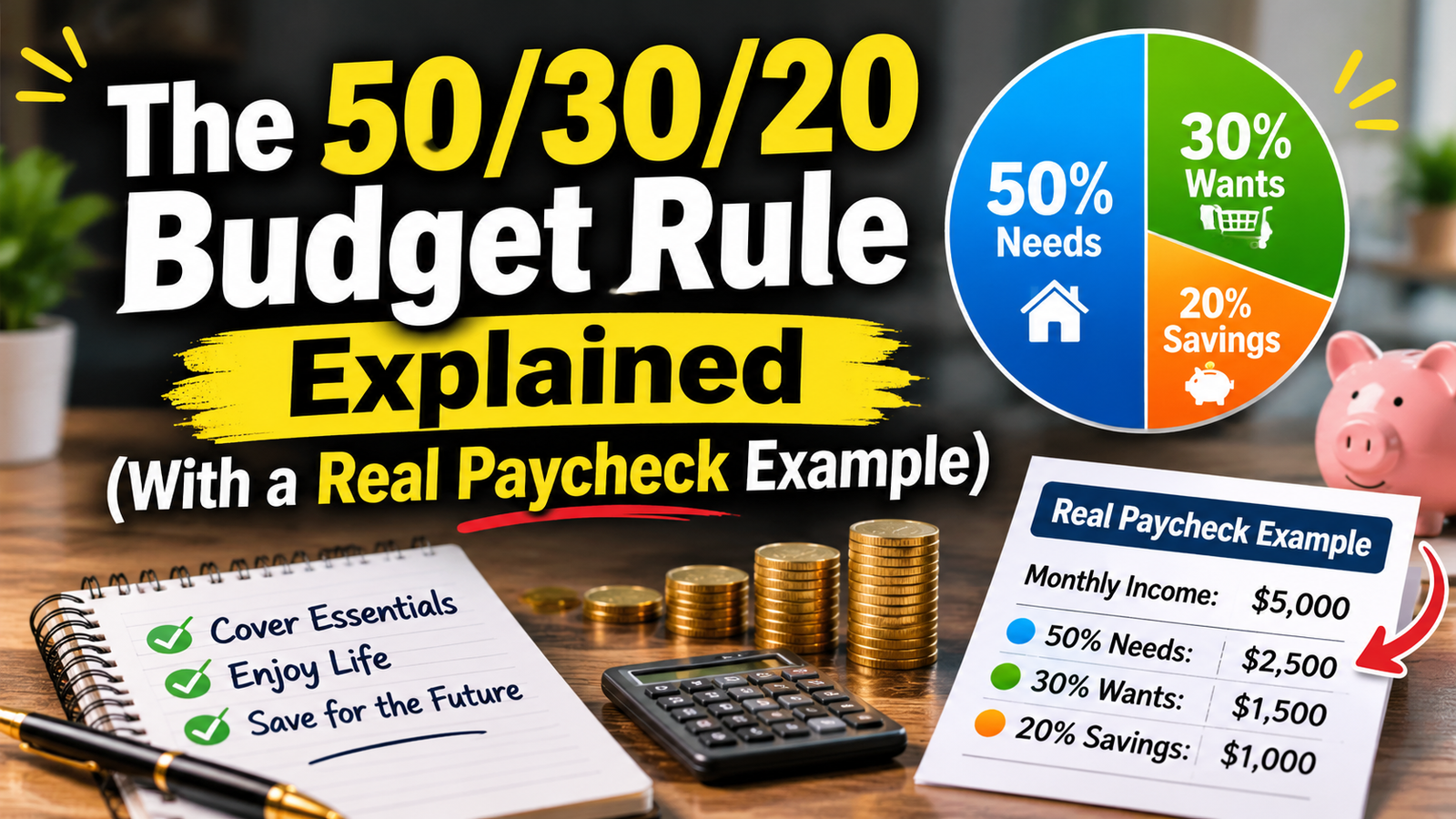
The 50/30/20 rule is a budgeting method that divides your after-tax income into three parts. According to a summary from Acorns, <cite index=”113-1″>50% covers needs, 30% covers wants, and 20% goes to savings and debt, and it was popularized by Elizabeth Warren and her daughter Amelia Warren Tyagi in their 2005 book All Your Worth.
Here is the breakdown:
| Bucket | Share | What it covers |
|---|---|---|
| Needs | 50% | Things you must pay to live and work |
| Wants | 30% | Things that make life enjoyable but are optional |
| Savings and debt | 20% | Building your future and paying off debt faster |
A key detail that people often miss: the percentages apply to your take-home pay, meaning the amount that actually lands in your bank account after taxes, not your gross salary.
Bucket 1: Needs (50%)
Needs are the expenses you can’t realistically skip without serious consequences. They include:
- Rent or mortgage payment
- Utilities (electricity, water, heat, basic internet)
- Groceries (not restaurant meals)
- Basic transportation, such as gas, car insurance, transit passes, and a necessary car payment
- Health insurance premiums and necessary medical costs
- Minimum payments on debts
- Basic phone service
- Childcare, if you need it in order to work
A helpful test: “If I stopped paying this, would it seriously harm my health, housing, job, or credit?” If yes, it’s a need.
Bucket 2: Wants (30%)
Wants are the things that make your life more enjoyable but aren’t essential. They include:
- Dining out, takeout, and coffee shops
- Streaming services and entertainment
- Shopping beyond basics, such as extra clothes and gadgets
- Hobbies, gym memberships, and classes
- Vacations and weekend trips
- Upgrades, such as a premium phone plan or a nicer car than you need
This bucket is the most flexible. It is also the one that gives you the most room to adjust when you need extra money for goals. And note that the rule gives you 30% for fun. That’s intentional. A budget that leaves no room for enjoyment usually gets abandoned.
Bucket 3: Savings and Debt Repayment (20%)
This bucket is about your future self. It includes:
- Building an emergency fund
- Contributing to retirement accounts such as a 401(k) or IRA
- Saving for goals like a home down payment
- Investing
- Extra payments on debt, above the required minimums (the minimums already count as needs)
If you have high-interest debt, direct much of this 20% toward it. Our guide on paying off $10,000 in credit card debt walks through the methods.
A Real Paycheck Example
Let’s use a realistic scenario. Say you earn a salary that leaves you with $4,000 per month in take-home pay. Your exact number depends on your state, benefits, and deductions, but this is a typical figure for a mid-range salary.
Here is how the formula divides it:
| Bucket | Percentage | Monthly amount |
|---|---|---|
| Needs | 50% | $2,000 |
| Wants | 30% | $1,200 |
| Savings and debt | 20% | $800 |
Now let’s fill in each bucket with real line items.
Needs: $2,000
| Expense | Amount |
|---|---|
| Rent | $1,100 |
| Utilities | $140 |
| Groceries | $350 |
| Transportation (gas, insurance, maintenance) | $250 |
| Phone | $60 |
| Health costs | $50 |
| Minimum debt payment | $50 |
| Total | $2,000 |
Wants: $1,200
| Expense | Amount |
|---|---|
| Dining out and takeout | $300 |
| Entertainment and streaming | $100 |
| Shopping and clothing | $200 |
| Gym and hobbies | $100 |
| Travel fund | $250 |
| Personal care | $100 |
| Gifts and miscellaneous | $150 |
| Total | $1,200 |
Savings and Debt: $800
| Goal | Amount |
|---|---|
| Emergency fund | $300 |
| Roth IRA or retirement savings | $250 |
| Extra debt payment | $250 |
| Total | $800 |
Notice how the plan is balanced. It covers the basics, includes real enjoyment, and moves $800 a month toward a stronger future. Over a year, that is $9,600 into savings and debt payoff, without tracking dozens of tiny categories.
How to Set It Up in 5 Steps
Step 1: Find your true take-home pay. Look at your recent pay stubs or bank deposits. If you get paid biweekly, multiply one paycheck by 26 and divide by 12 to estimate a monthly figure. If your income is irregular, use the lowest typical month as your baseline.
Step 2: Calculate your three targets. Multiply your take-home pay by 0.50, 0.30, and 0.20.
Step 3: Sort last month’s spending. Look at your bank and card statements and label each expense as a need, want, or savings. This is the revealing part, because most people are surprised by what they find.
Step 4: Adjust where you’re off. Compare your actual percentages with the targets, then decide what to change. Trimming wants is usually the easiest place to start.
Step 5: Automate. On payday, automatically transfer the savings portion to a separate account. Then you can spend the rest without guilt.
A Tip for Biweekly Paychecks
If you’re paid every two weeks, you receive 26 paychecks a year, which means two months have three paychecks. Base your monthly budget on two paychecks and treat the third as a bonus. Use it for emergency savings, debt payoff, or a big annual expense like car registration or holiday gifts.
What About 401(k) Contributions and Payroll Deductions?
This is a common point of confusion. Money deducted before it reaches your bank account can be treated like this:
- Retirement contributions taken from your paycheck, such as a 401(k), can be counted toward your 20% savings goal. If you already contribute 8% through payroll, you only need 12% more.
- Health insurance premiums taken from your paycheck are a need.
- Taxes are not counted in any bucket, since the rule starts after taxes.
When the 50/30/20 Rule Doesn’t Fit
The rule is a guideline, not a law. In many U.S. cities, housing costs alone can eat up 40% or more of take-home pay. Here is how to adapt.
Scenario 1: Needs Take 65% of Your Income
On a $4,000 take-home, that’s $2,600 in needs. You have a few ways to rebalance:
| Plan | Needs | Wants | Savings and debt |
|---|---|---|---|
| Protect savings | 65% ($2,600) | 15% ($600) | 20% ($800) |
| Balanced | 65% ($2,600) | 20% ($800) | 15% ($600) |
If your needs exceed 50%, the answer is to adjust the other two buckets, typically by trimming wants first. At the same time, look for ways to lower needs over time, such as getting a roommate, negotiating insurance, or refinancing.
Scenario 2: You Have Heavy Debt
There’s a common variation sometimes described as 50/20/30, where 30% of income goes to savings and debt while wants shrink to 20%. This is a good choice when you are in a debt payoff sprint, since it speeds up your timeline significantly.
Scenario 3: Your Income Is Low
When income is tight, needs may take 70% to 80% of your pay. That’s a reality for many households, not a personal failing. In this case, start with a smaller savings goal, such as 5%, and focus on a starter emergency fund. As your income grows, shift more toward savings.
Scenario 4: Your Income Is High
If you earn well, you might aim to save 30% or more, rather than 20%. The percentages are a floor, not a ceiling.
Needs vs Wants: The Gray Areas
Not everything fits neatly in a box. Here are some common borderline cases:
| Item | Need part | Want part |
|---|---|---|
| Groceries | Basic food | Premium or specialty items, restaurant meals |
| Phone | A basic plan | Expensive device or unlimited upgrades |
| Car | Reliable transportation | Luxury features or a more expensive model |
| Internet | A basic connection | Higher-tier speed you don’t need |
| Clothing | Work clothes, seasonal basics | Trendy extras |
Split these items into two lines. Count the basic version as a need and the extra as a want. This makes your budget more honest.
Pros and Cons of the 50/30/20 Rule
Pros
- Simple to remember and set up in 15 minutes
- Flexible. You don’t track every small purchase.
- Builds savings into your plan from the start
- Leaves room for enjoyment, which makes it easier to stick with
Cons
- May not fit high-cost areas or low incomes without adjustments
- The line between needs and wants can be fuzzy
- Doesn’t tell you exactly where to put your savings
- Less detailed than methods like zero-based budgeting
If you want more precision, you can pair 50/30/20 with a more detailed method, or with a budgeting app that tracks your spending automatically.
Your Turn: A Simple Worksheet
Fill in these blanks with your own numbers:
| Line | Your number |
|---|---|
| Monthly take-home pay | $_____ |
| Needs target (50%) | $_____ |
| Wants target (30%) | $_____ |
| Savings and debt target (20%) | $_____ |
| Actual needs last month | $_____ |
| Actual wants last month | $_____ |
| Actual savings and debt last month | $_____ |
| Biggest gap to fix | _____ |
It takes about 20 minutes, and many people find it eye-opening.
Tools That Make It Easier
- A basic spreadsheet. Free, flexible, and easy to customize.
- Budgeting apps. Many apps connect to your bank and sort spending automatically. Check privacy policies and fees before you connect accounts.
- Separate bank accounts. Some people open one account for bills, one for spending, and one for savings, and divide each paycheck between them.
- Pen and paper. There is no shame in this. The best tool is the one you will use.
Common Mistakes to Avoid
Using gross pay. The rule is based on take-home income. Using your pre-tax salary will give you inflated targets.
Hiding wants in the needs category. Calling every subscription an essential defeats the point.
Skipping savings until the end of the month. If you wait to see what is left, usually nothing is. Pay yourself first.
Giving up after one bad month. Budgets are meant to be adjusted. Learn from the overspend and move on.
Ignoring irregular expenses. Annual bills like insurance premiums, car repairs, and holidays can break a budget. Set aside a small amount monthly in a sinking fund.
Frequently Asked Questions
Is the 50/30/20 rule based on gross or net income? Net income, which is your after-tax take-home pay.
Where do student loans and credit card minimums go? Required minimum payments count as needs. Any extra payments beyond the minimum go in the 20% bucket.
Does the rule work if I have an irregular income? Yes. Base your budget on your lowest typical monthly income, and put extra earnings toward savings and debt.
What if my rent is more than 50% of my income? Adjust the other buckets, such as 65/15/20, and work on longer-term ways to lower housing costs or raise income.
Can couples use 50/30/20? Yes. Some couples combine their incomes, while others apply the percentages to each partner’s share of the household expenses. What matters is that both people agree on the system.
Is it better than zero-based budgeting? Neither is better in every case. 50/30/20 is simpler, while zero-based budgeting gives every dollar a job and offers more control. Many people start with 50/30/20 and add detail later.
Final Thoughts
The 50/30/20 rule isn’t magic, and it isn’t perfect. But it is one of the easiest ways to bring structure to your money without turning your life into a spreadsheet. It protects your needs, allows for enjoyment, and makes sure your future gets a seat at the table.
Start with your take-home pay, calculate your three numbers, and look at last month’s spending. Even if the numbers are far off, you will know exactly where you stand, and that is the first step toward financial freedom.
Disclaimer: This article is for educational purposes only and is not financial advice. The percentages are general guidelines, and examples use hypothetical figures. Your situation, income, and expenses may call for a different approach. Consider speaking with a qualified financial professional or a nonprofit credit counselor for personal guidance.