
By the LetsFinancialFreedom Team | Updated November 2026
Most people believe investing is for someone else. Someone with a finance degree, a big paycheck, or a friend who “knows a guy” on Wall Street. So the money sits in a savings account while inflation quietly nibbles away at it.
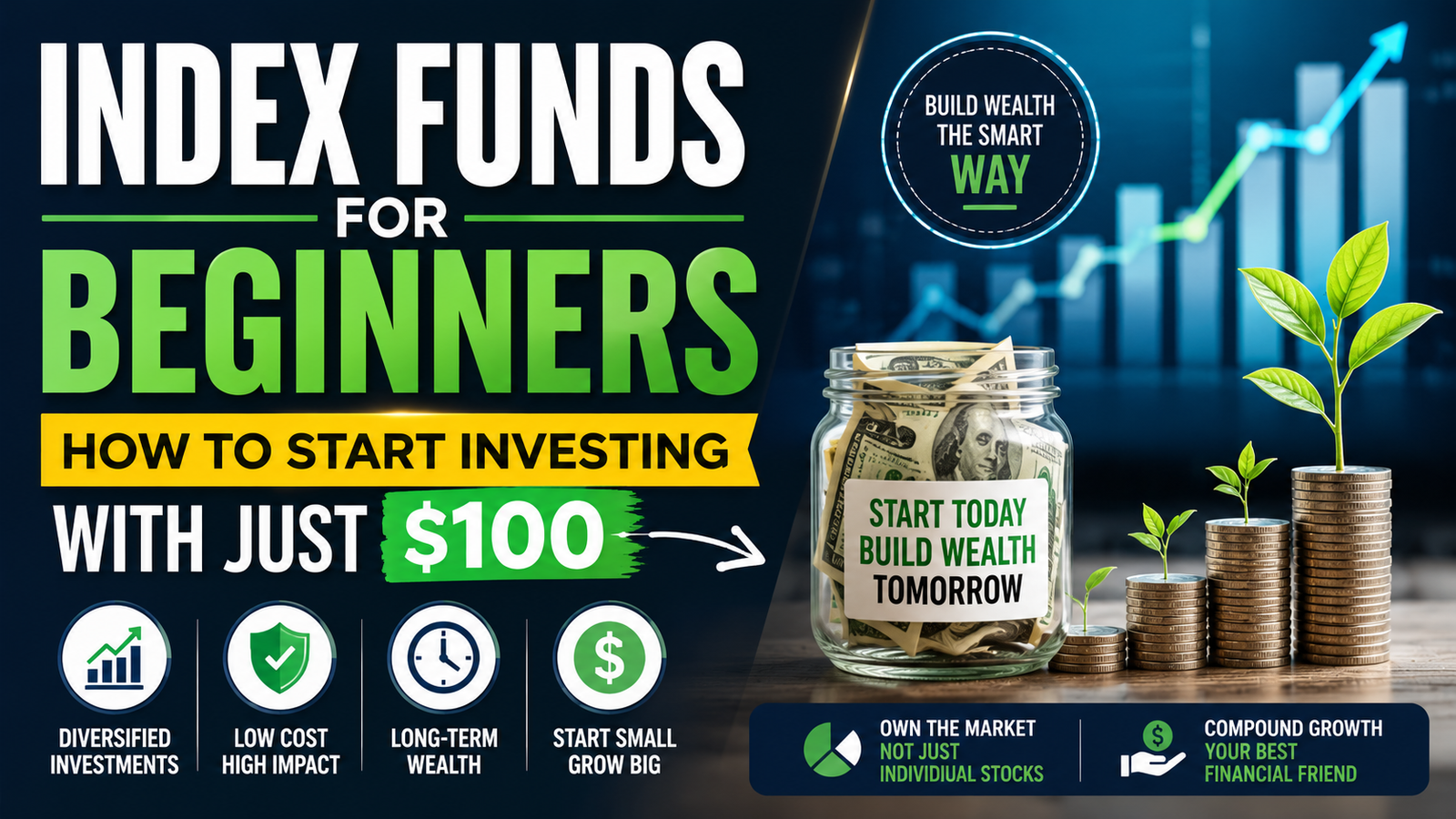
Here is the truth that changes everything: you can start investing with $100, and you don’t need to pick a single stock. Thanks to index funds and fractional shares, building a diversified investment portfolio is now simpler and cheaper than it has ever been.
In this guide, I’ll explain what an index fund is in plain English, why so many experts recommend them for beginners, which kinds to consider, and exactly how to make your first $100 investment this week. No jargon, no hype.
What Is an Index Fund?
An index is a list of companies used to measure part of the market. The most famous is the S&P 500, which tracks about 500 of the largest publicly traded companies in the United States.
An index fund is a fund that simply buys all the companies in an index, in roughly the same proportions. Instead of paying a manager to pick winners, the fund copies the list. When you invest in an S&P 500 index fund, you become a part-owner of hundreds of companies at once, from technology giants to banks, grocery chains, and healthcare firms.
Think of it as buying a basket of the whole market instead of betting on individual items.
Why Index Funds Work So Well for Beginners
1. Instant diversification. One purchase spreads your money across hundreds, sometimes thousands, of companies. If one business fails, it barely dents your overall investment.
2. Very low costs. Every fund charges a yearly fee called an expense ratio, shown as a percentage of your investment. Index funds are among the cheapest. For example, one comparison of popular S&P 500 funds listed expense ratios of <cite index=”97-1″>0.03% for Vanguard’s VOO, 0.015% for Fidelity’s FXAIX, and 0.02% for Schwab’s SWPPX</cite>. At 0.03%, <cite index=”95-1″>you pay just $3 per year on every $10,000 invested</cite>. Many actively managed funds charge 1% or more, which would be $100 per year on the same $10,000.
3. Simplicity. There’s no need to research individual companies, time the market, or watch the news every day.
4. Strong track record against stock pickers. Year after year, studies of fund performance have found that most professional managers of actively managed funds fail to beat their benchmark index over long periods, especially after fees. That’s not because they are unskilled, but because beating the market consistently is extremely difficult.
5. Low barriers to entry. Many funds now have no minimum investment, and many brokers let you buy fractional shares, so $100 goes to work immediately.
Index Fund vs ETF vs Mutual Fund
These terms get mixed up constantly, so here is a quick breakdown.
| Feature | Index mutual fund | Index ETF |
|---|---|---|
| What it is | A fund that tracks an index | A fund that tracks an index and trades like a stock |
| How it trades | Once per day, at the closing price | All day, at market prices |
| Minimum investment | Often $0 at some brokers, higher at others | Price of one share, or a few dollars with fractional shares |
| Automatic investing | Easy, in exact dollar amounts | Possible at many brokers with fractional shares |
| Examples | FXAIX, SWPPX | VOO, IVV, VTI |
Both are “index funds” in the way that matters. For a beginner, either works well. If your broker offers fractional ETF shares or a no-minimum index mutual fund, you can start with $100 either way.
The Main Types of Index Funds
S&P 500 funds. They track 500 large U.S. companies. Simple, popular, and a common core holding.
Total stock market funds. They hold nearly every publicly traded U.S. company, from giants to small businesses, giving you even broader exposure.
International funds. They give you exposure to companies in developed and emerging markets outside the U.S., which reduces your dependence on one country’s economy.
Bond index funds. They hold a broad collection of bonds. They are generally steadier than stocks, but typically offer lower long-term growth. Investors often add them as they approach their goals or retirement.
Target-date funds. These are funds of index funds that automatically adjust the mix between stocks and bonds as you approach a chosen year, such as 2060. They are popular in 401(k) plans because they are an all-in-one solution, though costs can be a bit higher than a DIY index fund, so check the expense ratio.
These are examples to help you learn, not personal recommendations. Fees and availability change, so confirm details with your broker.
Before You Invest Your First $100: A Quick Checklist
Investing is powerful, but it works best when the foundation is solid. Check these first:
- Do you have a starter emergency fund? Without one, a surprise expense might force you to sell investments at a bad time. If you don’t have one yet, see our guide on building a $1,000 emergency fund.
- Are you carrying high-interest debt? If you owe money on credit cards charging around 20% interest, paying that down will often beat any investment return you can reasonably expect.
- Does your employer offer a 401(k) match? If so, contribute enough to get the full match first. It’s an instant return on your money.
- Is this money you’ll need soon? Money you need within about five years generally doesn’t belong in stocks, because markets can drop right when you need to sell.
If you can check these boxes, you are ready.
Which Account Should You Use?
The account you choose affects your taxes, so it matters.
- 401(k) or 403(b): An employer plan with a high contribution limit. Great if there’s a match.
- Roth IRA: You contribute after-tax money, and qualified withdrawals in retirement are tax-free. We compare it with the Traditional IRA in another guide.
- Traditional IRA: You may get a tax deduction now and pay tax when you withdraw.
- Taxable brokerage account: No special tax benefits, but no contribution limits and no restrictions on when you withdraw. Good for goals outside of retirement.
For long-term retirement goals, many beginners start with a Roth IRA or their workplace plan. For a medium-term goal, like a home down payment in more than five years, a taxable account may make sense.
How to Invest Your First $100: Step by Step
Step 1: Choose a brokerage. Look for no account minimums, no trading commissions on stocks and ETFs, a good mobile app, and access to low-cost index funds. Large, established brokerages like Fidelity, Schwab, and Vanguard are popular choices, and many others exist. Make sure the firm is a member of SIPC, which protects your securities if the brokerage fails (it does not protect against market losses).
Step 2: Open the account. You will need your Social Security number, a government ID, and your bank details. It takes about 10 to 15 minutes.
Step 3: Fund the account. Link your bank and transfer your $100. It can take a day or two to clear.
Step 4: Pick your fund. For simplicity, choose one broad, low-cost fund, such as an S&P 500 or total market index fund. Look for an expense ratio under about 0.10%. Some funds have no minimum, such as <cite index=”92-1″>FXAIX, which carries an expense ratio of 0.015% and requires no minimum investment</cite>. If you prefer ETFs, check that your broker supports fractional shares so the whole $100 can be invested.
Step 5: Place the order. Enter the dollar amount and confirm. With a mutual fund, the order fills at the end of the trading day. With an ETF, use a market order or a limit order.
Step 6: Automate. Set up a recurring transfer and automatic investment, even if it’s only $25 or $50 per month. This step is the real secret. Consistent contributions matter far more than the size of your first deposit.
Step 7: Turn on dividend reinvestment. This automatically uses the dividends your fund pays to buy more shares, which helps your investment compound.
The Power of Starting Small and Staying Consistent
Let’s look at a simple hypothetical. Suppose you invest $100 every month for 30 years. The table shows what you could end up with at different average annual returns. These are illustrations, not predictions.
| Average annual return | Total you contributed | Approx. balance after 30 years |
|---|---|---|
| 5% | $36,000 | About $83,000 |
| 7% | $36,000 | About $122,000 |
| 9% | $36,000 | About $183,000 |
The stock market has historically delivered average returns of around 10% a year before inflation over very long periods, but there is no guarantee, and individual years can look very different. Recent years have been unusually strong: one analysis showed the S&P 500 returning <cite index=”105-1″>about 14.8% annualized over the 10 years ending January 2026</cite>. It would be unwise to count on that pace continuing, which is why the table uses more modest numbers.
Now compare fees. In the 7% scenario above, an investment that costs 1% more per year each year would grow at roughly 6% instead, ending near $100,000. That’s about $21,000 lost to fees on the same contributions. Low costs are one of the few things you can fully control.
Dollar-Cost Averaging: Your Built-In Safety Net
Dollar-cost averaging simply means investing a fixed amount on a regular schedule, regardless of what the market is doing. When prices are low, your money buys more shares. When prices are high, it buys fewer. Over time, this smooths out your average purchase price and removes the temptation to guess the perfect moment to buy.
Because most beginners invest from each paycheck, they’re already doing it without knowing the name.
Understand the Risks Before You Start
Index funds are diversified, but they are not risk-free. The stock market goes up and down, sometimes sharply.
- In 2008, during the financial crisis, the S&P 500 lost roughly 37%.
- In early 2020, the market fell by about a third in a matter of weeks before recovering.
- In 2022, the S&P 500 fell by roughly 18% for the year.
Historically, the market has recovered from each of these declines over time, but past performance doesn’t guarantee future results, and recoveries can take years. The practical lesson: only invest money you won’t need for at least five years, and try not to sell in a panic when prices drop. If seeing your balance fall by 20% would make you sell, consider a more conservative mix with some bonds.
Simple Portfolios for Beginners
You don’t need a complicated strategy. Here are three common approaches:
1. The one-fund approach. A single S&P 500 fund, total stock market fund, or target-date fund. Easy and effective.
2. The two-fund approach. A U.S. stock index fund plus an international stock index fund, for broader global exposure.
3. The three-fund approach. A U.S. stock fund, an international stock fund, and a bond fund. The mix between them depends on your age, goals, and comfort with risk.
Start simple. You can always add more later.
How Index Funds Are Taxed
- In a 401(k) or IRA: Growth is tax-deferred or, in a Roth, tax-free if rules are met. You generally don’t owe taxes on trades inside the account.
- In a taxable account: You may owe tax on dividends each year, and on capital gains when you sell for a profit. Assets held for more than one year typically qualify for lower long-term capital gains rates than those held for a year or less.
Index funds are usually quite tax-efficient because they trade infrequently, but you should still keep records and consult a tax professional if your situation is complicated.
Common Beginner Mistakes
Waiting for the perfect time. Time in the market tends to matter more than timing the market.
Checking your balance daily. Daily swings can tempt you into emotional decisions. Check in monthly or quarterly.
Chasing hot trends. Last year’s best-performing fund or sector is not guaranteed to do well next year.
Paying high fees. Watch for funds with expense ratios above 0.50%, trading commissions, and advisory fees you don’t understand.
Skipping the foundation. Investing while carrying high-interest debt and no emergency fund can leave you vulnerable.
Stopping contributions when the market drops. Falling prices mean your regular contribution buys more shares. Many successful long-term investors keep going through downturns.
Frequently Asked Questions
Can I really start investing with $100? Yes. Many brokers have no account minimums, and many index funds have no minimum or allow fractional shares, so $100 can be fully invested.
What is the best index fund for beginners? There’s no single best choice. A low-cost S&P 500 or total market fund is a common starting point. Focus on a low expense ratio, broad diversification, and availability at your broker.
Is an index fund the same as an ETF? Not exactly. An ETF is a type of fund that trades like a stock. Many ETFs track indexes, and so do some mutual funds.
How much should I invest each month? Start with an amount that doesn’t strain your budget, even $25 to $100, and raise it as your income grows. Many people work toward investing 10% to 15% of their income for retirement.
Can I lose money in an index fund? Yes. Values can fall, especially in the short term. Diversification and a long time horizon help, but there is no guarantee.
When can I withdraw my money? In a taxable account, anytime. In retirement accounts like IRAs and 401(k)s, withdrawals before age 59½ may trigger taxes and penalties, with some exceptions.
Final Thoughts
You don’t need a fortune to start building one. A single index fund, a modest monthly contribution, and the patience to leave it alone can take you a very long way. The hardest part is not the math or the market. It is taking the first step.
Open the account this week, invest your first $100, and automate the next one. In a decade, you’ll be glad you did.
Disclaimer: This article is for educational purposes only and is not investment, tax, or legal advice. All investing involves risk, including the possible loss of principal. Fund names are examples, not recommendations. Fees, minimums, and returns change over time and illustrations are hypothetical. Review fund prospectuses and consult a qualified financial professional before investing.