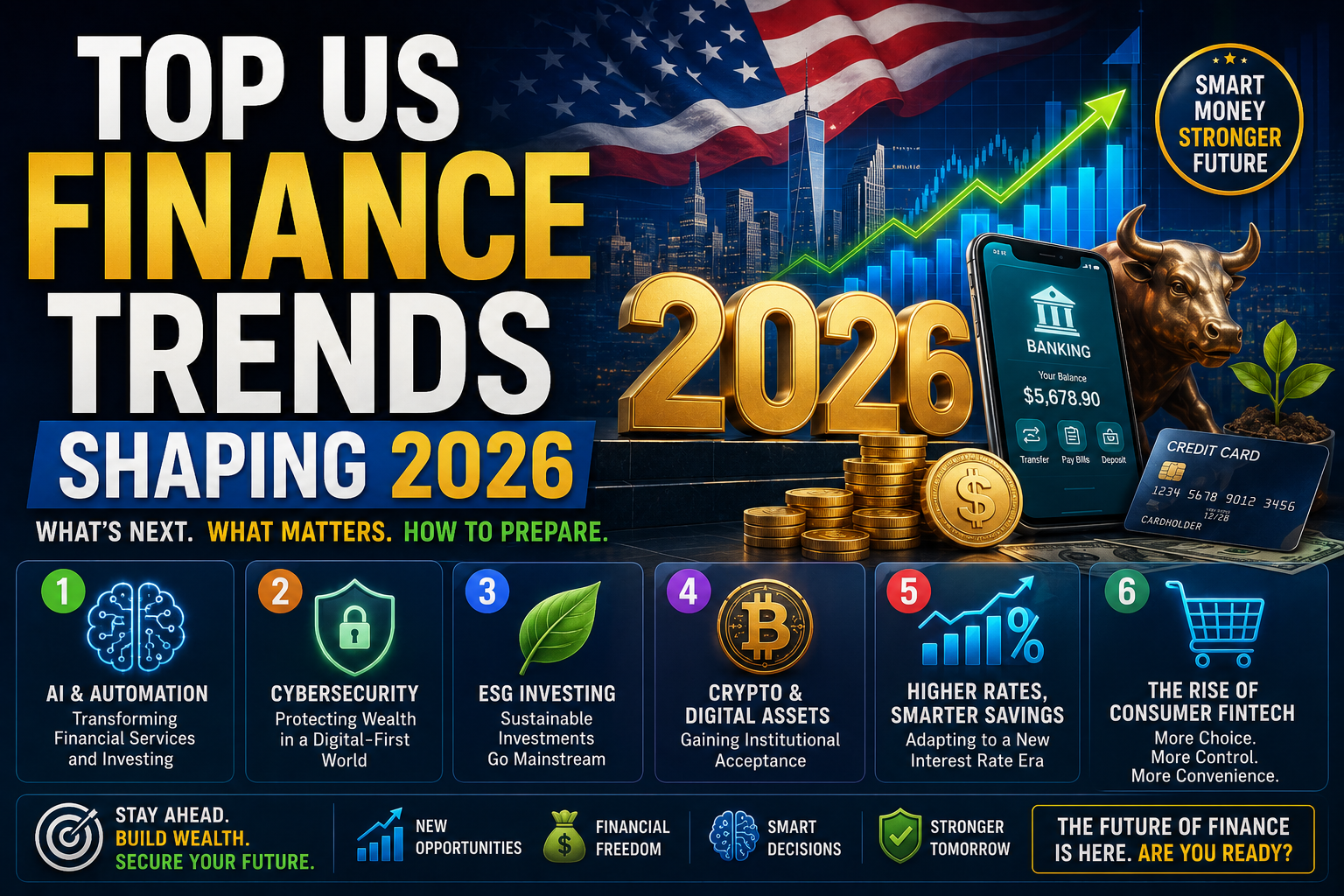
The US financial landscape in 2026 is being pulled in two directions at once. On one side, there’s record-breaking AI-driven investment, a resilient stock market, and a rapidly maturing digital-asset industry. On the other, millions of everyday American households are under real financial pressure, and the gap between the two is widening every quarter. Below is a deep dive into the trends defining US finance this year — from Wall Street to Main Street.
1. The AI Supercycle Keeps Accelerating
AI investment remains the single biggest force in US markets this year. <cite index=”6-1″>AI is no longer just a tech story in the US — it has spread into banks, healthcare, logistics, and utilities, and is now the anchor theme behind Wall Street’s bullish outlook on US stocks.</cite> Analysts point to record levels of capital expenditure and rapid earnings growth tied to AI as the biggest driver of overall market performance.
That momentum is also reshaping credit markets. <cite index=”7-1″>Demand for AI and data-center infrastructure is fueling a sharp rise in tech-sector debt issuance, as companies race to fund the buildout, with trillions of dollars in data-center capex still to be deployed.</cite> Private credit has become a major channel for financing this expansion, with alternative asset managers increasingly stepping in to fund AI infrastructure — including data centers and energy projects — alongside traditional bank lending.
This isn’t happening without scrutiny, though. Activist investors have begun pushing back on companies over how they’re allocating capital toward AI, questioning whether spending is translating into real returns and demanding more accountability from corporate boards on AI strategy.
2. Banks Are All-In on AI — Consumers, Less So
Banks have embraced AI for fraud detection, risk management, underwriting, and customer service, treating it as core infrastructure rather than an experiment. But trust remains a real hurdle among the people actually using these services. <cite index=”1-1″>Roughly 84% of American consumers say they have concerns about AI in banking, citing privacy, security, reduced human interaction, and the risk of errors, and just over half doubt AI’s accuracy outright.</cite> A meaningful share of consumers are also demanding regular audits and more transparency before they’ll trust AI-driven decisions about their money.
Interestingly, the appetite for AI isn’t uniform. <cite index=”1-1″>US consumers are generally comfortable with AI for fraud detection but show far less enthusiasm for AI-powered virtual assistants or automated financial recommendations.</cite> That’s pushing banks to be more selective about where they deploy AI-facing tools — leaning into behind-the-scenes uses like fraud prevention while moving more cautiously on anything that replaces human judgment in customer-facing decisions.
3. Fraud Threats Are Evolving Just as Fast
As AI becomes more embedded in financial services, so does AI-enabled fraud. Scam tactics are growing more sophisticated, with synthetic identities and AI-generated schemes increasingly used to defraud both individuals and institutions. Because a large share of consumers remain uneasy about AI-driven fraud prevention specifically, banks are under pressure to combine advanced analytics and behavioral biometrics with clear customer education — not just better algorithms, but better communication about how those algorithms work.
4. Neobanks Shift From Growth to Value
For years, digital-only “neobanks” competed primarily on growth — racking up new users and expanding aggressively. In 2026, that playbook is changing. Neobanks are increasingly being judged on profitability and the durability of their business models rather than sign-up numbers alone, as both investors and regulators expect these firms to prove they can generate sustainable value, not just scale. This shift is pushing many digital banks to diversify into wealth products, lending, and other higher-margin services rather than relying purely on deposit growth.
5. Interest Rates and the Stock Market: Cautiously Bullish
<cite index=”7-1″>Fixed-income markets could see a rally in the first half of 2026 as the Federal Reserve pivots from fighting inflation toward more balanced policy, with the 10-year Treasury yield expected to dip before climbing back above 4% by year-end.</cite> Major banks are recommending an overweight position in US equities for 2026, betting that strong earnings, rate cuts, and AI-driven productivity gains will keep the bull market intact. <cite index=”7-1″>Tailwinds also include a reduction in corporate tax bills through 2026 and 2027, positive operating leverage, and the return of pricing power for many US companies.</cite>
At the same time, inflation risk hasn’t disappeared. <cite index=”9-1″>Rising oil prices and geopolitical tension in the Middle East have pushed headline inflation and long-term Treasury yields higher, adding downward pressure on the housing market through higher mortgage rates.</cite> Fiscal policy is also expected to turn modestly restrictive later in the year as the earlier boost from tax cuts fades, creating a more complicated backdrop for growth than a simple “rate cuts equal good times” story would suggest.
6. A Bigger, Broader IPO Market
<cite index=”4-1″>2026 is shaping up as a stronger year for public offerings, with larger, later-stage companies coming to market across sectors, backed by financial sponsors, retail investors, and multiple capital-raising channels.</cite> This marks a shift from the cautious IPO environment of recent years, and reflects renewed confidence among both issuers and investors that market conditions can support bigger listings.
7. Private Credit’s Expanding Role
Private credit has moved from a niche corner of finance to a central pillar of how AI infrastructure gets funded. <cite index=”4-1″>Alternative asset managers are deploying capital into AI infrastructure — including data centers and energy projects — with private credit playing a key role in financing that growth, even as firms grow more disciplined about managing the risks tied to such a large, multi-year buildout.</cite> This growth is also drawing more scrutiny from regulators and ratings agencies concerned about how much leverage and risk is quietly building up outside the traditional banking system.
8. Stablecoins and Crypto Move Into the Mainstream
Perhaps the most structurally significant shift in US finance this year is happening in digital assets. <cite index=”12-1″>Following passage of the GENIUS Act, the first comprehensive federal framework for dollar-backed stablecoins, banks and payment firms have begun adopting and issuing stablecoins under the new rules, with the total stablecoin market surpassing $250 billion and accounting for a significant share of on-chain transactions.</cite>
<cite index=”11-1″>Regulators must publish implementing rules for dollar-backed stablecoin issuers under the GENIUS Act by mid-2026, with the framework taking full effect within six months after that — making this the year stablecoin regulation moves from theory into practice.</cite> <cite index=”11-1″>Banking supervisors are also expected to expand what banks can do with cryptoassets in 2026, covering custody, stablecoin issuance, reserve management, payments, staking, and tokenization.</cite>
Beyond stablecoins, lawmakers are working to pass broader market-structure legislation that would clarify which federal agency oversees which types of digital assets — a long-standing source of uncertainty that industry groups say has held back US innovation. Whether or not that legislation passes this year, US regulators are generally moving toward a lighter-touch, more permissive stance on crypto than in previous years, which is drawing more traditional financial institutions into the space.
9. Everyday Americans Are Feeling the Squeeze
This is arguably the most sobering trend of 2026, and the one furthest removed from the optimism on Wall Street. <cite index=”8-1″>About 34% of Americans — roughly 88 million adults — now describe their financial situation as “struggling” or “in crisis,” up sharply from 22% in 2021, a 55% increase in five years.</cite> <cite index=”8-1″>The share of people living paycheck to paycheck has climbed from 42% to 54% over the same period, and the number who say they worry about money every day has risen from 44% to 53%.</cite>
The pain isn’t evenly distributed. <cite index=”8-1″>The biggest increases in financial hardship have come among women, Gen X, lower-income households, and people carrying debt.</cite> Homeowners, by contrast, have generally weathered this period with less difficulty than renters — underscoring how much housing status now shapes financial resilience in America.
There’s a genuine silver lining, though. <cite index=”8-1″>The number of Americans who keep a monthly budget has risen from 39% to 47% since 2021, with the biggest gains coming from Gen Z and middle-income households, and those working with a financial advisor have jumped from 35% to 45% over the same period.</cite> Payment habits are shifting too: <cite index=”8-1″>debit card usage has grown from 35% to 41% since 2021, while reliance on credit cards has eased slightly, with Gen Z showing the sharpest pullback from credit cards of any generation.</cite>
And despite the pressure, Americans haven’t given up on the future. <cite index=”8-1″>A majority say they’re better off today than they were five years ago, and nearly three-quarters expect to be financially better off five years from now.</cite>
10. A “K-Shaped” Economy
Economists increasingly describe 2026 as a K-shaped recovery: AI-driven companies and higher-income households are pulling ahead, while lower-income groups face weaker job demand and shrinking spending power. <cite index=”6-1″>In the broader economy, strong corporate capital spending stands in contrast to weaker labor demand and consumer spending, and the divide between high- and low-income households continues to widen.</cite> This divergence — rather than any single indicator like GDP growth or the unemployment rate — may be the defining feature of the US economy in 2026, and it’s shaping up to be a central theme in how both policymakers and investors think about the year ahead.
The Bottom Line
2026 is a year of contrasts for US finance. Record AI investment, a resilient stock market, and a maturing crypto industry are creating enormous opportunity at the top of the economy. At the same time, a growing share of American households are struggling with day-to-day costs, even as more of them take positive steps like budgeting and seeking financial advice. Whether you’re an investor tracking the AI supercycle or a household trying to manage a tighter budget, the widening gap between these two realities is likely to be the story that defines US finance well beyond this year.
This article is for informational purposes only and should not be taken as financial or investment advice.
