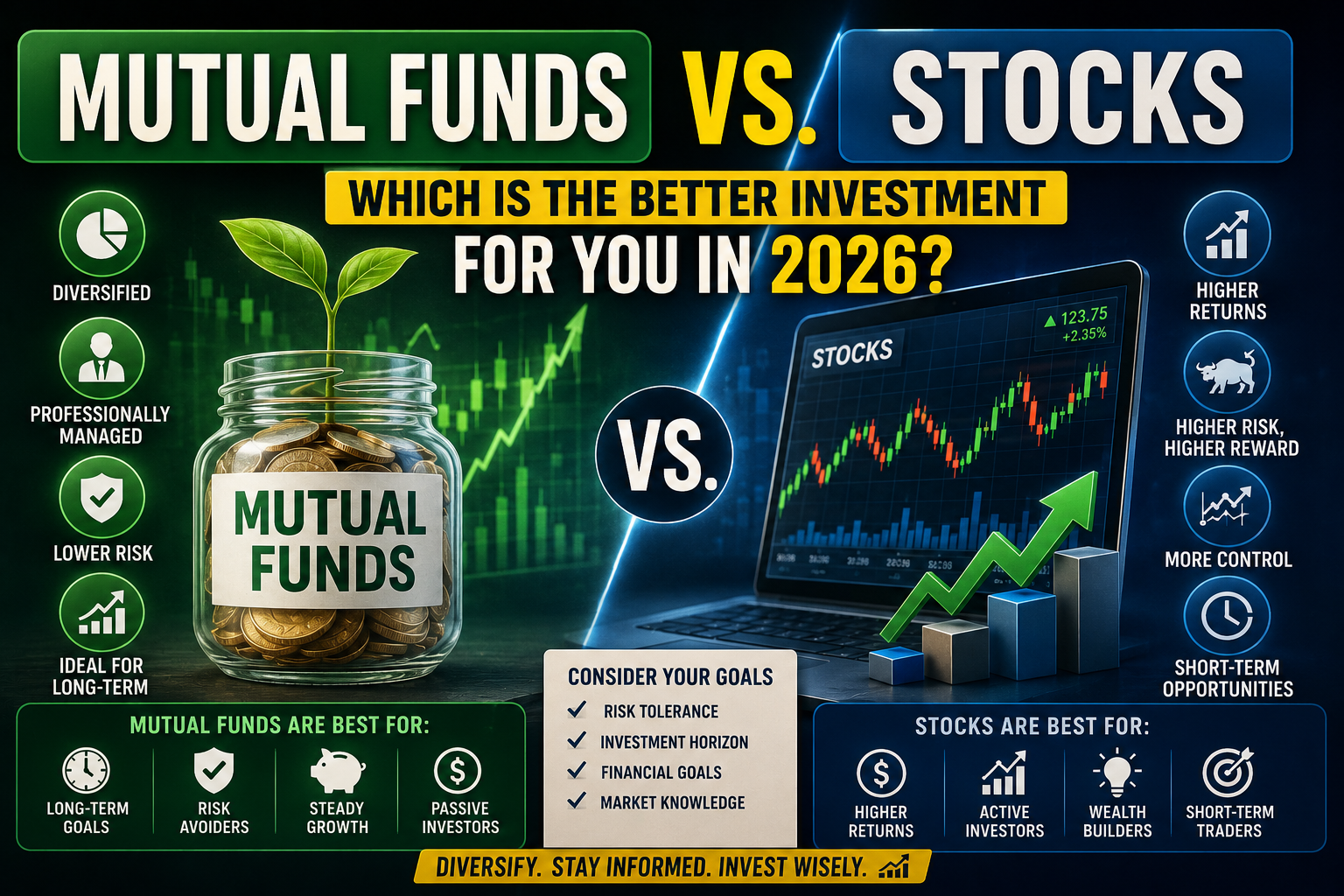
You have decided you want to start investing. You have your emergency fund in place, your high-interest debt is gone, and you are ready to put your money to work. Now comes one of the most common questions every new investor faces: should I invest in mutual funds or individual stocks?
It sounds like a simple either-or question. But the honest answer is more nuanced than that — and getting it right can make a significant difference in your investment returns, your stress levels, and your long-term financial outcomes.
Both mutual funds and stocks are legitimate, proven ways to build wealth over time. Both have real advantages. Both carry real risks. And for many investors, the best approach is not choosing one over the other — it is understanding how they work, knowing which fits your situation, and potentially using both in the right proportions.
This guide breaks down everything you need to know about mutual funds versus stocks in plain language — no jargon, no confusion — so you can make a confident, informed decision about where to put your money in 2026.
What Are Stocks?
When you buy a stock, you are purchasing a small ownership stake in a single company. If you buy shares of Apple, you literally own a tiny fraction of Apple Inc. — its products, its cash, its intellectual property, its future profits. Your return on that investment comes from two sources: the stock price going up over time (capital appreciation), and dividends, which are periodic cash payments some companies make to shareholders from their profits.
The potential upside of individual stocks is significant. Early investors in companies like Amazon, Netflix, or Microsoft have made extraordinary returns — in some cases turning modest investments into life-changing wealth. But that potential comes with equally significant downside risk. A single company can decline dramatically or even go bankrupt due to poor management decisions, competitive pressure, regulatory problems, or broader economic shifts. When a company goes under, shareholders can lose everything they invested.
The other major challenge with individual stocks is the time and knowledge required to invest in them well. To invest in individual stocks with any real skill, you need to research companies — reading earnings reports, analyzing competitive landscapes, understanding industry trends, evaluating management quality, and monitoring your holdings on an ongoing basis. For people who enjoy this process, it can be genuinely rewarding. For people who do not have the time, interest, or expertise to do it well, it is a recipe for expensive mistakes.
What Are Mutual Funds?
A mutual fund pools money from many investors and uses that combined capital to invest in a diversified collection of assets — most commonly stocks, but also bonds, real estate, and other securities. Instead of you deciding which companies to buy, a fund manager (or an index algorithm) makes those decisions according to the fund’s stated investment objective.
The most important distinction within mutual funds is between actively managed funds and index funds (passive funds):
Actively managed mutual funds employ professional portfolio managers who research the market, pick stocks, and attempt to outperform the broader market. These funds charge higher fees — typically 0.5% to 1.5% or more annually — to pay for all that professional management.
Index funds do not try to beat the market. Instead, they simply track a market index — like the S&P 500, which includes the 500 largest publicly traded companies in America. An S&P 500 index fund automatically holds all 500 companies in proportion to their size. No stock picking. No active trading. Just mirroring the market. These funds charge dramatically lower fees — often just 0.03% to 0.10% annually.
Here is the critical insight that most beginning investors do not know: the vast majority of actively managed funds fail to outperform simple index funds over the long term. Study after study, decade after decade, has shown that professional fund managers with teams of analysts, sophisticated tools, and years of experience consistently underperform basic S&P 500 index funds after accounting for their fees. This is one of the most well-documented findings in all of financial research — and it is why Warren Buffett, arguably the greatest investor in history, has repeatedly advised most people to simply invest in low-cost index funds.
The Key Differences: Mutual Funds vs. Stocks Side by Side
Let’s put the main differences in clear perspective:
Diversification
Stocks: When you buy individual stocks, each share represents one company. To achieve meaningful diversification through individual stocks, most experts suggest owning at least 20 to 30 different companies across multiple industries. Building and managing that portfolio requires real time and attention.
Mutual Funds: A single mutual fund — especially an index fund tracking the S&P 500 — instantly gives you ownership in hundreds or thousands of companies. One purchase. Instant diversification. When one company in the fund has a bad year, it is one of 500 holdings, not your entire portfolio.
Winner for beginners: Mutual funds, and it is not close.
Risk Level
Stocks: The risk of individual stocks is concentrated. If a company you are heavily invested in faces a scandal, loses a major contract, or gets disrupted by a competitor, your investment can drop 30%, 50%, or more in a short period. Individual stocks can and do go to zero.
Mutual Funds: Because they are diversified across many companies, mutual funds absorb individual company setbacks far better. Yes, the entire fund can still go down during market-wide downturns — but the catastrophic risk of a single company failure is largely eliminated.
Winner for beginners: Mutual funds, for the risk management they provide.
Potential Returns
Stocks: Individual stocks have produced some of the highest returns in investing history. An early investment in the right company at the right time can generate returns of 1,000%, 5,000%, or more over a decade. The upside ceiling is theoretically unlimited.
Mutual Funds: Index funds targeting the S&P 500 have historically returned about 10% per year on average. That is not as thrilling as a 10-bagger stock pick — but it is steady, reliable, and backed by the collective growth of the American economy over decades.
Winner: Stocks win on potential upside — but that potential comes with much higher risk. For consistent, reliable long-term growth, index funds win on a risk-adjusted basis.
Time and Effort Required
Stocks: Investing successfully in individual stocks is genuinely time-intensive. You need to research companies before buying, monitor them regularly, follow earnings calls, stay current on industry developments, and make active buy and sell decisions. For investors who enjoy this process, it can be engaging and rewarding. For those who do not, it quickly becomes either a burden or a source of costly, emotion-driven mistakes.
Mutual Funds: Once you select a fund and set up automatic contributions, mutual fund investing requires almost no ongoing time. An index fund needs zero monitoring — it simply tracks the market automatically. This makes it the ideal choice for busy people who want their money growing without demanding their constant attention.
Winner: Mutual funds for investors who value simplicity and their time.
Fees and Costs
Stocks: At most major brokerages today, buying and selling individual stocks is commission-free. Your only cost is the price of the shares themselves.
Mutual Funds: Index funds have extraordinarily low fees — the Vanguard S&P 500 Index Fund charges just 0.04% annually. That means on a $10,000 investment, you pay just $4 per year. Actively managed mutual funds charge much more — typically 0.5% to 1.5% or higher — and those fees compound into significant amounts over decades.
Winner: Individual stocks and passive index funds tie for lowest cost. Actively managed funds lose badly on fees.
Emotional Discipline
Stocks: Individual stock investors tend to check their portfolios more often and react more emotionally to price movements. When a stock you own drops 20% in a week, the pressure to sell is intense — even if the long-term outlook for the company is perfectly fine. This emotional volatility leads many individual stock investors to buy high and sell low, destroying returns in the process.
Mutual Funds: The built-in diversification of mutual funds naturally reduces the emotional intensity of watching your portfolio. A bad week for one company in your S&P 500 index fund barely registers in your overall balance. This calmer experience makes it easier for investors to stay the course during market downturns — which is ultimately the most important factor in long-term investment success.
Winner: Mutual funds, particularly for beginning investors who have not yet experienced a major market correction.
Who Should Invest in Stocks?
Individual stock investing is a better fit for investors who:
- Have already established a solid foundation of index fund investments and want to add some active investing on top
- Genuinely enjoy researching companies, reading earnings reports, and following industry trends
- Can dedicate consistent time each week to monitoring their portfolio
- Have the emotional discipline to hold through volatility without panic-selling
- Are comfortable with the possibility that any individual company could lose a significant portion of its value
- Are limiting individual stock exposure to no more than 5% to 10% of their total portfolio
The key word in that last point is “limiting.” Even experienced investors who enjoy stock picking generally keep the majority of their portfolio in diversified index funds, with a smaller allocation to individual stocks. The high-risk, high-reward nature of individual stocks makes them best suited as a supplement to a diversified core — not as the core itself.
Who Should Invest in Mutual Funds (Specifically Index Funds)?
Index fund investing is the right starting point for:
- Beginning investors who are new to the market
- Busy professionals who do not have time to research individual companies
- Anyone who wants their money working for them without demanding constant attention
- Investors who prioritize steady, reliable long-term returns over the possibility of dramatic short-term gains
- People who want broad market exposure with a single, simple investment
- Anyone who has tried individual stock picking and found it stressful, time-consuming, or unprofitable
The evidence in favor of index funds over actively managed investments is overwhelming. Over any 15-year period, the vast majority of actively managed mutual funds underperform their benchmark index after fees. Simple, low-cost index funds do not just win by a little — they win consistently, predictably, and by significant margins over long time horizons.
The Smart Approach for Most Americans in 2026
Here is the practical framework that most certified financial planners recommend for beginning investors — and that the evidence strongly supports:
Step 1: Build your core with index funds. Start by putting 90% to 95% of your investment money into a small number of low-cost index funds. An S&P 500 index fund covers 500 of America’s largest companies. Adding a total international stock market index fund gives you global diversification. These two funds, held consistently over decades, form the foundation of a powerfully effective investment portfolio.
Step 2: If you want to pick individual stocks, limit it. Once your index fund core is established, if you genuinely enjoy researching companies and want to try individual stock picking, allocate 5% to 10% of your portfolio to it. This gives you the engagement of active investing without putting your financial future at serious risk if a few picks go wrong.
Step 3: Automate everything. Set up automatic monthly contributions to your index funds. Do not try to time the market. Invest consistently, through market ups and downs, and let compounding do its work over years and decades.
Step 4: Keep fees ruthlessly low. Every percentage point in annual fees is money that compounds against you over time. Stick with index funds charging 0.03% to 0.10% in expense ratios. Avoid actively managed funds with fees above 0.50% unless you have a very specific reason.
A Quick Look at the Numbers
To understand just how much fees and returns compound over time, consider this comparison:
Two investors each put $5,000 per year into their investment accounts for 30 years.
- Investor A chooses an actively managed mutual fund with a 1% annual expense ratio and average returns of 8% per year (after the fee drag).
- Investor B chooses a low-cost S&P 500 index fund with a 0.04% expense ratio and average returns of 9.96% per year.
After 30 years:
- Investor A: approximately $566,000
- Investor B: approximately $820,000
The difference — over $250,000 — comes almost entirely from fees compounding against Investor A over three decades. Same savings habit. Same time horizon. Dramatically different outcome, driven almost entirely by the cost of the fund.
This is why fee awareness is not a minor detail. It is one of the most important investment decisions you will ever make.
The Bottom Line
Stocks and mutual funds are not enemies — they are complementary tools, each suited to different purposes and different investor profiles.
For most Americans in 2026 — especially those just starting their investment journey — low-cost index mutual funds and ETFs are the right foundation. They provide instant diversification, require minimal time and expertise, charge very low fees, and have delivered consistent long-term returns that outperform the vast majority of active alternatives.
Individual stocks can play a role in a portfolio once that foundation is in place — but as a supplement, not a substitute. Keep stock picking to a small, ring-fenced portion of your total investments, and approach it with the understanding that it requires real research, real discipline, and a genuine tolerance for concentrated risk.
Build your foundation with index funds. Let compounding work for decades. And if you love the thrill of researching individual companies, do it with a small portion of your portfolio — as an adventure, not as your primary wealth-building strategy.
That is how most of the world’s most successful long-term investors actually invest. It works. And in 2026, it has never been more accessible to any American who wants to start.
