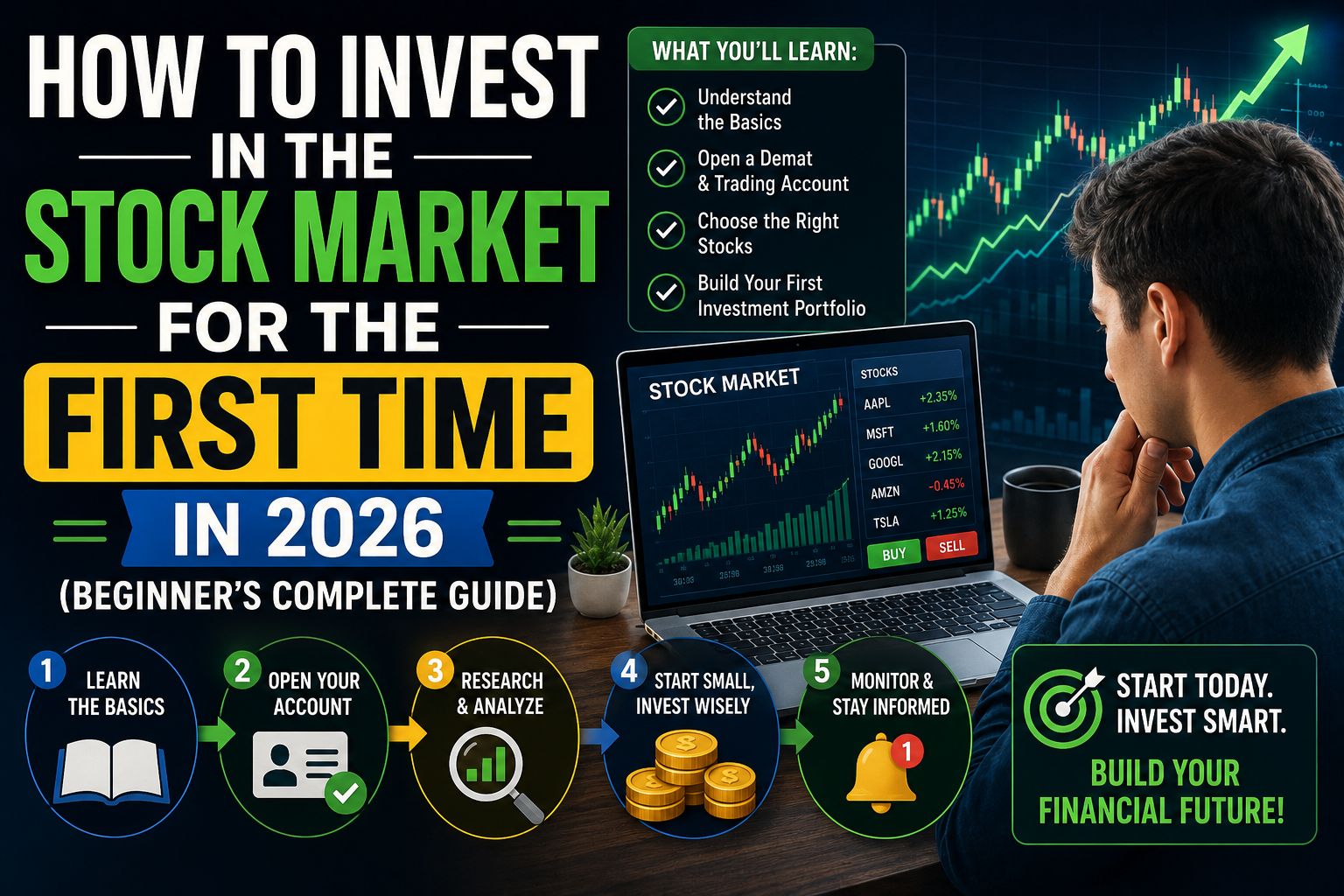
Let’s start with a number that should get your attention: the stock market has historically returned around 10% per year on average over the long term. That means $10,000 invested today — left untouched for 20 years — could grow to over $67,000 without you lifting a finger. No second job. No side hustle. Just the power of compounding returns doing what it does best over time.
Yet despite this, 38% of Americans still do not own a single share of stock. Millions of people are sitting on the sidelines — not because they cannot afford to invest, not because the opportunity is not there, but because the stock market feels intimidating, complicated, and risky to someone who has never done it before.
The truth is, investing in the stock market for the first time is far simpler than most people think. You do not need a finance degree. You do not need thousands of dollars to start. You do not need to spend hours analyzing charts or following CNBC. In 2026, with fractional shares, commission-free brokerages, and automated investing tools widely available, there has never been a lower barrier to entry for the beginning investor.
This guide is going to walk you through everything you need to know to invest in the stock market for the first time — from the foundational concepts, to opening your first account, to making your first investment — in plain language with no jargon and no confusion.
Let’s get started.
Why Investing Matters More Than Ever in 2026
Before we talk about how to invest, it is worth understanding why investing is not optional if you are serious about financial freedom.
Saving money in a regular bank account is a losing game in the long run. The national average interest rate on a traditional savings account is just 0.38%. Inflation in 2026 is running at 3.8%. That means money sitting in a standard savings account is actually losing purchasing power every single year — your dollars buy less in 2027 than they do today.
Investing in the stock market is how ordinary Americans have built real wealth over generations. About 62% of U.S. adults — roughly 167 million people — already own stock in some form, most through index funds, mutual funds, or workplace retirement accounts like a 401(k). The wealth gap in America is, in large part, an investing gap. Those who invest build wealth over time. Those who do not fall further behind.
The good news is that starting is easier than it has ever been. And starting early — even with a small amount — is far more powerful than waiting until you have “enough” money to invest.
Step 1: Make Sure You Are Ready to Invest
Before you invest a single dollar in the stock market, there are two financial foundations that need to be in place. Skipping these steps and investing first is one of the most common and costly mistakes beginning investors make.
Foundation #1: Have an emergency fund.
The stock market goes up — but it also goes down. Sometimes dramatically. The S&P 500 dropped 37% in 2008. It dropped roughly 34% in early 2020. If you invest money you might need in the short term and the market drops right when you need to access those funds, you will be forced to sell at a loss.
Before investing in stocks, you need at least three to six months of essential living expenses sitting in a high-yield savings account — money that is completely separate from your investments and completely untouched by market movements. This financial cushion is what allows you to leave your investments alone during downturns instead of panic-selling at the worst possible moment.
Foundation #2: Pay off high-interest debt first.
If you are carrying credit card balances charging 20% to 25% interest, paying those off delivers a guaranteed 20% to 25% return — which beats what the stock market offers in most years. There is no investment that consistently beats paying off high-interest debt. Get that off your plate first.
Low-interest debt — like a mortgage or a federal student loan under 5% — does not need to be paid off before you start investing. The math works in your favor to invest while carrying those. But high-interest consumer debt needs to go first.
Once your emergency fund is built and your high-interest debt is gone, you are genuinely ready to start investing.
Step 2: Understand the Basics — What You Are Actually Buying
When you invest in the stock market, you are buying ownership stakes in real companies. A single share of Apple stock means you own a tiny fraction of Apple Inc. — its products, its profits, its future growth. When Apple does well, your shares become more valuable. When Apple struggles, your shares drop.
Here are the key investment types every beginning investor needs to understand:
Stocks (Individual Shares) A stock represents partial ownership in a single company. Buying 10 shares of a company means you own a small piece of that business. Individual stocks can deliver huge returns — but they can also drop to zero if a company fails. Concentrating your money in a few individual companies is one of the riskiest things a beginning investor can do.
Index Funds An index fund is a collection of stocks that tracks a specific market index — like the S&P 500, which contains the 500 largest publicly traded companies in America. When you buy a single S&P 500 index fund, you instantly own a tiny slice of 500 companies: Apple, Microsoft, Amazon, Berkshire Hathaway, and 496 others. This instant diversification dramatically reduces the risk that any single company’s failure can hurt you significantly.
Index funds are widely considered the best starting point for beginning investors — and for good reason. They are low-cost, broadly diversified, require no stock-picking expertise, and have outperformed the majority of actively managed funds over long time periods.
ETFs (Exchange-Traded Funds) ETFs work very similarly to index funds but trade on stock exchanges like individual stocks — meaning you can buy and sell them throughout the trading day. Many S&P 500 ETFs, like the Vanguard S&P 500 ETF (VOO) or the iShares Core S&P 500 ETF (IVV), have extremely low expense ratios and are excellent choices for beginning investors.
Mutual Funds Mutual funds pool money from many investors to buy a collection of stocks or bonds, managed by a professional fund manager. Index mutual funds (which passively track an index rather than being actively managed) are low-cost and highly recommended. Actively managed mutual funds tend to have higher fees and often underperform simple index funds over the long term.
Robo-Advisors A robo-advisor is an automated investment platform that builds and manages a diversified portfolio for you based on your goals, timeline, and risk tolerance. You answer a few questions, deposit money regularly, and the platform handles everything else. Popular options include Betterment, Wealthfront, and Fidelity Go. Robo-advisors typically charge about 0.25% of your account balance annually — a small fee for a completely hands-off investing experience.
Step 3: Choose the Right Account Type
Where you invest matters almost as much as what you invest in. The right account type can save you thousands of dollars in taxes over your investing lifetime.
401(k) — Start Here If Your Employer Offers One
If your employer offers a 401(k) retirement plan with a matching contribution, this is your very first investing priority — no exceptions. An employer match is a 100% instant return on your investment. If your company matches 50% of your contributions up to 6% of your salary, and you earn $60,000 per year, contributing 6% ($3,600) gets you an additional $1,800 from your employer for free. That is an immediate 50% return before the market does anything.
Contribute at least enough to get the full employer match before putting money anywhere else.
Roth IRA — The Most Powerful Account for Most Beginners
A Roth IRA (Individual Retirement Account) allows you to invest after-tax dollars and let them grow completely tax-free. When you withdraw the money in retirement, you owe zero taxes on the gains — even if your $5,000 investment has grown to $80,000. That tax-free compounding over decades is extraordinarily powerful.
In 2026, you can contribute up to $7,000 per year to a Roth IRA ($8,000 if you are 50 or older). Income limits apply — for single filers, the ability to contribute begins phasing out at $150,000 in annual income. For most beginning investors, a Roth IRA is the single most valuable investing account available.
Traditional IRA
A Traditional IRA allows you to contribute pre-tax dollars, reducing your taxable income now. You pay taxes when you withdraw the money in retirement. This can be advantageous if you expect to be in a lower tax bracket in retirement than you are now.
Taxable Brokerage Account
Once you have maxed out your 401(k) match and your Roth IRA, a regular taxable brokerage account is the next step. There are no contribution limits and no restrictions on withdrawals, but you will owe taxes on dividends and capital gains each year.
Step 4: Open Your First Brokerage Account
Opening a brokerage account in 2026 takes about 10 to 15 minutes and can be done entirely online from your phone. Here is what to look for when choosing a brokerage:
Zero commission trades. All major brokerages now offer commission-free stock and ETF trades. This was not always the case — a few years ago, every trade cost $5 to $10. Today, Fidelity, Charles Schwab, and Vanguard all offer $0 commission trades on stocks and ETFs.
No account minimums. Most major brokerages have eliminated minimum opening balances entirely. You can open a Fidelity or Schwab account with literally $1.
Fractional shares. Fractional share investing allows you to buy a portion of a single share rather than a whole share. This means you can invest in Amazon or Google even if a single share costs hundreds or thousands of dollars. Look for a brokerage that offers fractional shares if you are starting with a small amount.
Strong educational resources. As a beginner, you will have questions. Brokerages like Fidelity and Charles Schwab offer extensive free educational content, tutorials, and tools to help new investors learn as they go.
Top beginner-friendly brokerages in 2026:
- Fidelity — No minimums, fractional shares, excellent educational tools, outstanding customer service
- Charles Schwab — No minimums, fractional shares, comprehensive investment options
- Vanguard — The pioneer of low-cost index fund investing; excellent for long-term buy-and-hold investors
- Betterment or Wealthfront — Best for complete beginners who want a fully automated, hands-off approach
Step 5: Make Your First Investment
You have your account open. Now what do you actually buy?
For the vast majority of beginning investors, the answer is simple: a broad market index fund or ETF.
Specifically, a fund that tracks the S&P 500 — the 500 largest companies in America — is the most widely recommended starting point. Here is why: instead of trying to pick individual stocks (which even professional fund managers struggle to do consistently), you are simply buying the entire U.S. stock market in one purchase. Your performance will mirror the overall market, which over long periods has averaged around 10% per year.
Three excellent starting investments for beginners:
- VOO (Vanguard S&P 500 ETF) — Tracks the S&P 500. Extremely low expense ratio of just 0.03%. One of the most popular ETFs in the world.
- IVV (iShares Core S&P 500 ETF) — Also tracks the S&P 500 with a similarly low 0.03% expense ratio. Great alternative to VOO.
- VTI (Vanguard Total Stock Market ETF) — Tracks the entire U.S. stock market, not just the 500 largest companies. Offers slightly broader diversification than an S&P 500 fund.
These three options are simple, diversified, low-cost, and exactly what most financial experts recommend for beginning investors. You do not need anything more complicated than this to start building meaningful wealth over time.
Step 6: Invest Consistently — The Power of Dollar-Cost Averaging
One of the biggest questions beginning investors ask is: when is the right time to invest? Should I wait for the market to drop? Should I wait until things are less uncertain?
The answer, backed by decades of research, is: invest now and invest consistently. Trying to time the market — waiting for the “perfect” moment to buy — is a strategy that even professional investors consistently fail at. Time in the market beats timing the market, every single time over long periods.
The strategy that works best for most beginning investors is called dollar-cost averaging: investing a fixed amount of money at regular intervals — say, $100 or $200 every two weeks or every month — regardless of what the market is doing. When prices are high, your fixed amount buys fewer shares. When prices drop, your fixed amount buys more shares. Over time, this averages out your cost per share and removes the emotional pressure of trying to time your purchases perfectly.
Most brokerages allow you to set up automatic recurring investments. Set it up once, connect it to your paycheck schedule, and let it run. Automation is the single most powerful tool available to the beginning investor because it removes emotion and procrastination from the equation entirely.
The Most Common Beginner Investing Mistakes to Avoid
Trying to pick individual stocks. The temptation to buy the “hot” stock you heard about from a friend or saw trending on social media is real — and almost always leads to poor outcomes. Even professional fund managers with teams of analysts fail to beat simple index funds consistently. Start with broad index funds and build knowledge before ever touching individual stocks.
Checking your portfolio every day. Daily market fluctuations are noise. The stock market drops regularly — sometimes dramatically — before recovering and reaching new highs. Investors who check their portfolios constantly tend to make emotional decisions (selling when scared, buying when excited) that destroy long-term returns. Check your investments quarterly, not daily.
Panic-selling during market downturns. Market drops feel terrifying — but they are completely normal and temporary for patient investors. Every major market crash in American history has been followed by a recovery to new highs. The investors who sold during the 2020 pandemic crash locked in their losses and missed one of the fastest recoveries in market history. Stay invested. Stay calm.
Waiting until you have “enough” to start. There is no minimum amount required to start investing in 2026. Many platforms allow you to begin with $1 thanks to fractional shares. Starting with $25 per month is infinitely better than waiting until you have $500. Time is the most powerful force in investing. Every month you wait is a month of compounding you will never get back.
Ignoring fees. Expense ratios — the annual fees charged by funds — compound just like returns do. A fund charging 1% annually does not sound like much, but over 30 years it can cost you tens of thousands of dollars compared to an equivalent fund charging 0.03%. Always choose low-cost index funds over high-fee actively managed alternatives.
How Much Should a Beginner Invest?
This is one of the most common questions — and the most freeing answer is: whatever you can consistently afford. The amount matters far less than the habit.
A general financial planning guideline is to invest at least 15% of your gross income toward retirement. If you cannot hit 15% right now, start wherever you can — 3%, 5%, $50 per month. Build the habit, automate it, and increase your contribution every time your income goes up or a debt gets paid off.
The math on starting early is staggering. A 25-year-old who invests $200 per month in a broad market index fund and earns an average 10% annual return will have approximately $700,000 by age 65. A 35-year-old doing the same thing will have roughly $250,000. Same monthly investment. Same return. The only difference is 10 years of time — and it costs $450,000 in the final balance.
The best time to start investing was ten years ago. The second best time is today.
The Bottom Line
Investing in the stock market for the first time does not require perfect knowledge, perfect timing, or a large amount of money. It requires three things: starting, being consistent, and being patient.
Build your emergency fund. Open a Roth IRA or contribute to your 401(k). Buy a simple S&P 500 index fund. Set up automatic contributions. Leave it alone for the long term.
That is it. That is the strategy that has built more ordinary American millionaires than any other approach in history. Not day trading. Not cryptocurrency speculation. Not picking the next hot stock. Just consistent, low-cost, long-term investing in the broad market — started as early as possible and left to compound over time.
You do not need to be a financial expert to build real wealth in the stock market. You just need to start.
