By letsfinancialfreedom.com
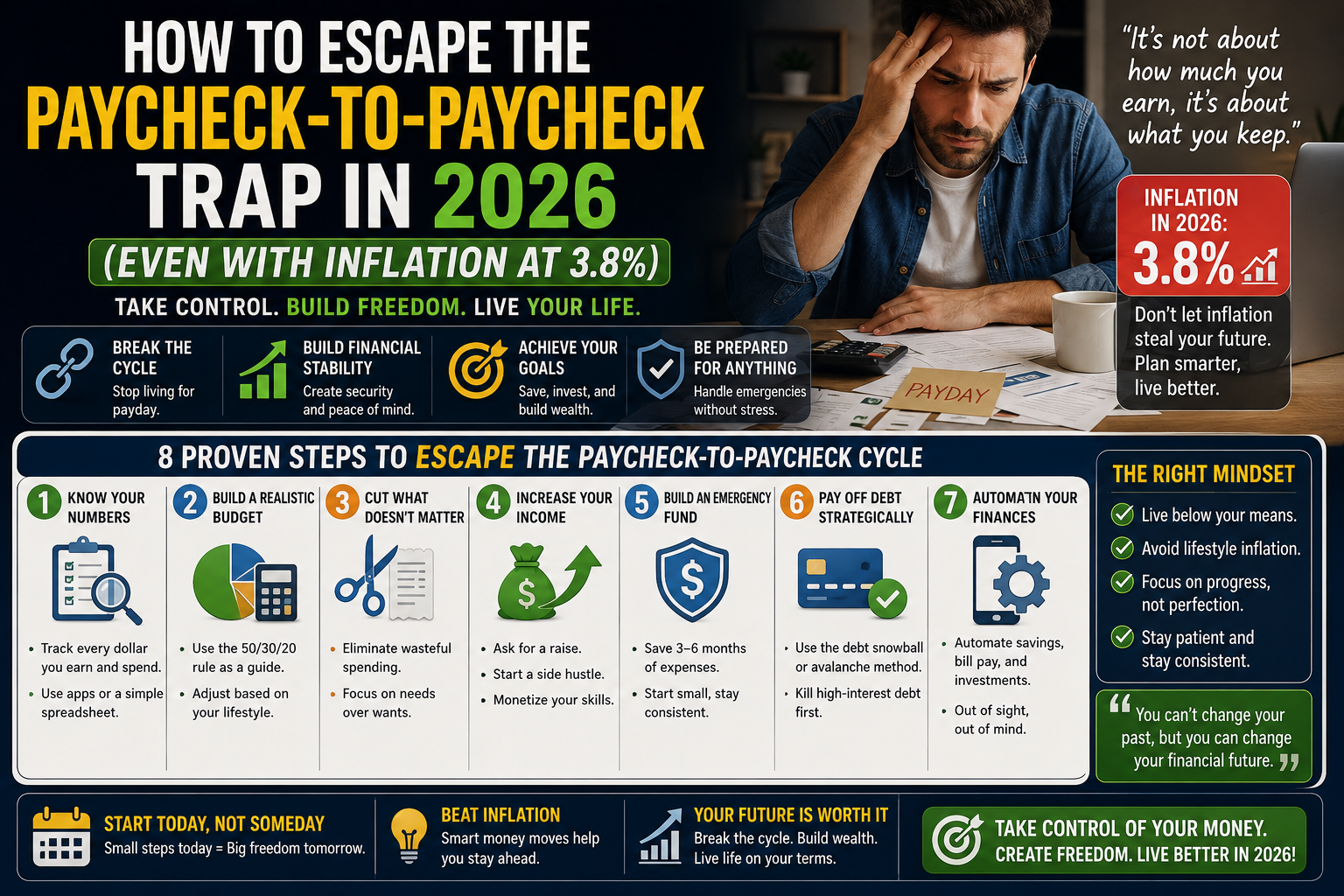
Are you tired of watching your bank account hit zero just days before your next paycheck? You are not alone. In 2026, more than half of all Americans — 54% to be exact — are living paycheck to paycheck. That number has jumped sharply from 42% just five years ago, and with inflation still running at 3.8%, the financial pressure on everyday families has never felt heavier.
But here is the truth no one is telling you: living paycheck to paycheck is not a life sentence. It is a cycle — and like every cycle, it can be broken. In this guide, we are going to walk you through exactly how to escape the paycheck-to-paycheck trap in 2026, with practical, real-world steps that work even when money feels impossibly tight.
Let’s get started.
Why So Many Americans Are Stuck in This Trap
Before we fix the problem, we need to understand it. The paycheck-to-paycheck cycle is not simply about “not earning enough money.” Plenty of middle-income households earning $60,000, $70,000, even $80,000 a year still find themselves broke by the 25th of every month.
So what is really going on?
Inflation is eating your raise. Even if your salary went up in the past year, inflation at 3.8% means that a bag of groceries, a tank of gas, and your monthly utility bill all cost more than they did 12 months ago. Your paycheck may look bigger on paper, but it is buying less in real life.
Lifestyle creep is a silent killer. When income goes up — even slightly — spending tends to rise with it. A slightly nicer apartment, a streaming subscription here, a DoorDash order there. These small upgrades quietly drain hundreds of dollars every single month.
There is no financial cushion. Without an emergency fund, any unexpected expense — a car repair, a medical bill, a broken appliance — forces you to raid your next paycheck before it even arrives. This is the core reason the cycle keeps repeating itself.
Debt payments swallow income. Credit card debt in America hit $1.25 trillion in early 2026. If a chunk of your paycheck goes straight to minimum payments every month, you are effectively working to pay your past self’s spending decisions — leaving nothing left for today or tomorrow.
Understanding these root causes is the first step. Now let’s talk about how to actually fix them.
Step 1: Know Exactly Where Your Money Is Going (The Money Audit)
You cannot change what you do not measure. The very first thing you need to do is conduct a full money audit — and most people skip this step because it is uncomfortable. Looking at your real spending is like stepping on a scale after the holidays. It stings. But it is absolutely necessary.
Here is how to do it:
- Pull your last 30 days of bank and credit card statements. Do not guess. Look at the actual numbers.
- Categorize every single expense. Housing, food, transportation, subscriptions, dining out, entertainment, debt payments, and miscellaneous.
- Total up each category. You will likely be surprised — or even shocked — by what you find.
Most people discover two or three categories where they are significantly overspending without even realizing it. Common culprits include food delivery apps, multiple streaming services, impulse Amazon purchases, and coffee shops.
This audit is not about making yourself feel bad. It is about getting honest so you can make smarter decisions going forward. Once you know where your money is actually going, you have the power to redirect it.
Step 2: Build a Simple Budget That You Will Actually Stick To
The word “budget” makes a lot of people cringe. It sounds restrictive, complicated, and boring. But a good budget is not a financial prison — it is a plan that tells your money where to go instead of wondering where it went.
For most people in 2026, the simplest and most effective budgeting method is the 50/30/20 Rule:
- 50% of your take-home pay goes to needs: rent/mortgage, groceries, utilities, transportation, insurance, and minimum debt payments.
- 30% of your take-home pay goes to wants: dining out, entertainment, subscriptions, shopping, and hobbies.
- 20% of your take-home pay goes to savings and extra debt payments.
If your current spending does not match these percentages — and for most paycheck-to-paycheck households, the “needs” category is often eating 70% or more of income — that is a clear signal that something needs to change.
Practical tip: Use a free budgeting app like YNAB (You Need A Budget) or Mint to track your spending automatically. These apps connect to your bank accounts and categorize transactions in real time, so you always know where you stand without having to manually add up receipts.
The key to making a budget work is consistency. Set aside 10 minutes every Sunday evening to review the past week and plan for the week ahead. This one habit alone can transform your financial life over the course of a few months.
Step 3: Cut the Expenses That Are Quietly Draining You
Once you have your budget in place, it is time to get strategic about cutting expenses. This does not mean eliminating all joy from your life. It means identifying the spending that is costing you the most while delivering the least value.
Here are the highest-impact cuts to consider:
Audit your subscriptions. The average American pays for 4 to 6 streaming services, a gym membership they rarely use, several app subscriptions, and various monthly boxes. Go through your bank statement and cancel everything you have not actively used in the last 30 days. This single step can free up $80 to $150 per month for many households.
Cut your grocery bill without cutting quality. Switch to store-brand products for pantry staples. Plan your meals for the week before you shop so you are not buying food that ends up in the trash. Shop at discount grocery stores like Aldi or Lidl when possible. A family of four can realistically save $200 to $300 per month on groceries with a little planning.
Renegotiate your bills. Call your internet provider, your insurance company, and your phone carrier. Ask them point-blank: “What is the best rate you can give me right now?” Many providers have retention discounts they will offer if you simply ask. This five-minute phone call has saved people hundreds of dollars per year.
Cook at home more. The average American spends over $3,000 per year on restaurants and food delivery. Even cutting this in half saves $1,500 annually — that is $125 per month that could go directly into savings or debt repayment.
Every dollar you free up from unnecessary spending is a dollar you can put to work for your future.
Step 4: Build Your Emergency Fund — Starting With Just $1,000
One of the primary reasons people stay stuck in the paycheck-to-paycheck cycle is the absence of any financial cushion. Without savings, a single unexpected expense — a flat tire, an urgent dental visit, a home repair — derails your entire financial plan and sends you reaching for a credit card or a payday loan.
The solution is an emergency fund. And here is the most important thing to know about it: you do not need to save three to six months of expenses all at once. That goal can feel so overwhelming that people never start. Instead, set a first milestone of just $1,000.
One thousand dollars will not cover every emergency, but it will handle most of them. It means the next time life throws you an unexpected bill, you can pay it in cash without borrowing, without missing a payment, and without breaking your budget for the next month.
Here is how to build your $1,000 emergency fund as fast as possible:
- Sell things you no longer need. Go through your home and list items on Facebook Marketplace, eBay, or Poshmark. Old electronics, clothes, furniture, and sports equipment can generate several hundred dollars in a matter of weeks.
- Direct any windfalls straight to savings. Tax refunds, birthday money, work bonuses — resist the urge to spend them and put them directly into a dedicated savings account.
- Automate a small transfer on payday. Even $25 or $50 automatically transferred to savings the moment your paycheck hits your account adds up to $600 to $1,200 per year without you having to think about it.
Once you hit $1,000, keep going. The goal is eventually three to six months of living expenses in a high-yield savings account. In 2026, the best high-yield savings accounts are still offering around 4% to 5% annual percentage yield — meaning your money actually grows while it sits there waiting to be used.
Step 5: Attack Your Debt Strategically
Debt is the engine that keeps the paycheck-to-paycheck cycle running. As long as a significant portion of your income is going to minimum payments on credit cards, personal loans, or buy-now-pay-later plans, you will never have enough breathing room to get ahead.
There are two proven methods for paying off debt:
The Debt Snowball Method: Pay the minimum on all debts, then put every extra dollar toward your smallest balance first. Once that debt is paid off, roll that payment into the next smallest balance. This method gives you quick psychological wins that build momentum and motivation.
The Debt Avalanche Method: Pay the minimum on all debts, then put every extra dollar toward the debt with the highest interest rate first. This method saves you the most money in interest over time.
Which one should you choose? If you need motivation and small wins to stay on track, go with the Snowball. If you are highly disciplined and want to minimize total interest paid, go with the Avalanche. Either method works — the best one is the one you will actually stick to.
One powerful move many people overlook: call your credit card company and ask for a lower interest rate. Surprisingly, many cardholders who ask receive a reduction. A lower APR means more of each payment goes to principal instead of interest, helping you pay off debt faster.
Step 6: Find Extra Income — Even a Little Makes a Big Difference
Cutting expenses can only take you so far. At some point, increasing your income is the most powerful move you can make to break the paycheck-to-paycheck cycle for good.
You do not need to land a massive promotion or start a million-dollar business. Even an extra $300 to $500 per month can completely change your financial trajectory.
Here are some realistic ways to earn extra income in 2026:
Freelance your existing skills. If you write, design, code, do bookkeeping, manage social media, or have any professional skill, there are people willing to pay for it online. Platforms like Upwork, Fiverr, and Toptal connect freelancers with paying clients every single day.
Deliver for gig apps. DoorDash, Instacart, Uber Eats, and Amazon Flex allow you to earn money on your own schedule. While these are not long-term career solutions, they are excellent for generating extra cash while you are building your financial foundation.
Sell your time for tasks. TaskRabbit and similar platforms allow you to earn money helping people with moving, furniture assembly, handyman work, yard work, and other physical tasks.
Rent out what you own. If you have a spare room, rent it on Airbnb. If you have a car you are not using full-time, rent it on Turo. Even renting out a parking spot can generate passive income.
Ask for a raise. Many people overlook the simplest source of extra income — their current employer. If you have been delivering results and have not had a raise in the past 12 months, prepare a short case outlining your contributions and ask for one. The worst they can say is no.
Step 7: Change Your Mindset About Money
None of the practical steps above will stick without a shift in how you think about money. The paycheck-to-paycheck cycle is not just a mathematical problem — it is also a psychological one.
Stop using money as an emotional outlet. Retail therapy, stress eating out, splurging after a hard day — these habits feel good in the moment but make your financial situation worse. Start identifying the emotional triggers that lead to impulsive spending and find healthier ways to cope.
Play the long game. The choices you make today about spending, saving, and debt repayment will determine the financial life you have five years from now. Every dollar saved today is not just a dollar — it is a dollar that can grow, a dollar that is building your freedom.
Talk about money. One of the biggest obstacles to financial progress is the social stigma around discussing money. Find a trusted friend, a spouse, or an online community (like personal finance subreddits or Facebook groups) where you can share your goals, your progress, and your struggles. Accountability accelerates results.
Celebrate small wins. Paid off a credit card? Built your first $500 in savings? Cut your grocery bill by $100 this month? These are real victories. Acknowledge them. Celebrate them (without spending money, of course). Building financial momentum takes time, and recognizing progress keeps you motivated for the long haul.
The Bottom Line
Living paycheck to paycheck in 2026 is an incredibly common experience — but it does not have to be a permanent one. With inflation still putting pressure on American wallets and household debt at record highs, the system is not exactly making it easy. But here is the empowering reality: the steps to break the cycle are available to you right now, regardless of your income level.
Start with awareness. Build a simple budget. Cut the expenses that are not serving you. Create even a small emergency fund. Attack your debt with a clear plan. Find ways to earn a little more. And most importantly — change the story you are telling yourself about money.
Financial freedom does not happen overnight. But every single step you take today moves you further away from the paycheck-to-paycheck trap and closer to the life you actually want to live.
