By letsfinancialfreedom.com
Let’s be honest — most people have tried to budget at some point in their lives. They downloaded a fancy app, filled out a spreadsheet, maybe even wrote their goals on a sticky note on the fridge. And then, somewhere around the second or third week, life happened, and the budget quietly disappeared.
Sound familiar?
Here is the thing: the problem is rarely that people are bad with money. The problem is that most budgets are built the wrong way from the very beginning. They are too complicated, too restrictive, or just completely out of touch with real life. And when a budget does not match your reality, it fails. Every. Single. Time.
In 2026, with inflation still pressing down on American households, credit card balances sitting at a staggering $1.25 trillion, and over half of all Americans living paycheck to paycheck, getting your monthly budget right has never been more important — or more urgent.
The good news? Creating a budget that actually sticks is not complicated. It does not require a finance degree or expensive software. It requires honesty, a clear framework, and a plan you will genuinely use. This guide gives you exactly that.
Let’s build your budget — the right way.
Why Most Americans Do Not Have a Working Budget
Before we dive into the how, it helps to understand the why. If budgeting is so important, why do so many people fail at it or never start at all?
The most common reason is intimidation. People assume that budgeting means obsessing over every dollar, depriving themselves of anything enjoyable, or spending hours each week crunching numbers. None of that is true — but the perception alone is enough to keep millions of people from ever starting.
The second reason is a lack of clarity about where money actually goes. According to the Bureau of Labor Statistics, the average American household spends over $61,000 per year — but most people dramatically underestimate what they spend on food delivery, dining out, and subscription services. When you do not know your real numbers, you cannot build a realistic plan.
The third reason is that most people start budgeting the wrong way: they set restrictions before they understand their habits. It is like going on a strict diet without first understanding what you eat. It is unsustainable from day one.
The approach you are about to learn fixes all three of these problems.
Step 1: Start With Your Real Take-Home Income
Every solid budget begins in the same place — your actual income after taxes and deductions. This is called your net income, and it is the only number that truly matters when building a monthly budget.
Do not use your gross salary (the big number on your employment offer letter). Use the amount that actually hits your bank account each month. These two numbers can be dramatically different once taxes, health insurance premiums, retirement contributions, and other deductions are taken out.
How to calculate your monthly net income:
- If you are paid biweekly, multiply your net paycheck by 26 and divide by 12.
- If you are paid twice a month (semi-monthly), simply multiply by 2.
- If you have multiple income sources — a second job, freelance work, child support, rental income — add them all in, but use conservative estimates for anything that is not consistent.
Quick example: Let’s say your gross salary is $4,500 per month. After federal taxes, state taxes, Social Security, Medicare, and health insurance, your actual take-home pay comes out to around $3,900. Your entire budget should be built around $3,900 — not $4,500. Using gross income is one of the most common budgeting mistakes Americans make, and it sets your plan up to fail before you even begin.
Write this number down. It is the foundation of everything that follows.
Step 2: Track Your Current Spending Honestly (The Eye-Opening Step)
This is the step most people skip — and it is the most important one. Before you can tell your money where to go, you need to understand where it is currently going.
Pull up your last 60 days of bank statements and credit card statements. Go through every single transaction and categorize it. Common categories include:
- Housing: Rent or mortgage, renter’s insurance
- Transportation: Car payment, gas, insurance, parking, public transit
- Food: Groceries, restaurants, coffee shops, food delivery apps
- Utilities: Electric, water, gas, internet, phone
- Subscriptions: Streaming services, gym memberships, apps, magazines
- Debt payments: Credit card minimums, student loans, personal loans
- Healthcare: Insurance copays, prescriptions, gym
- Personal & Misc: Clothing, haircuts, household items, gifts
Once you have categorized everything, total up each category and compare the total to your net income. Most people discover one of two things — either they are spending more than they earn (which explains why the credit card balance keeps creeping up), or they are spending significantly more in certain categories than they ever realized.
This exercise is not about judging yourself. It is about clarity. And clarity is where all real financial change begins.
Step 3: Choose a Budgeting Method That Fits Your Life
Now that you know your income and your current spending patterns, it is time to choose a budgeting framework. There is no single best method — the right one is whichever one you will actually use consistently. Here are the three most popular approaches for Americans in 2026:
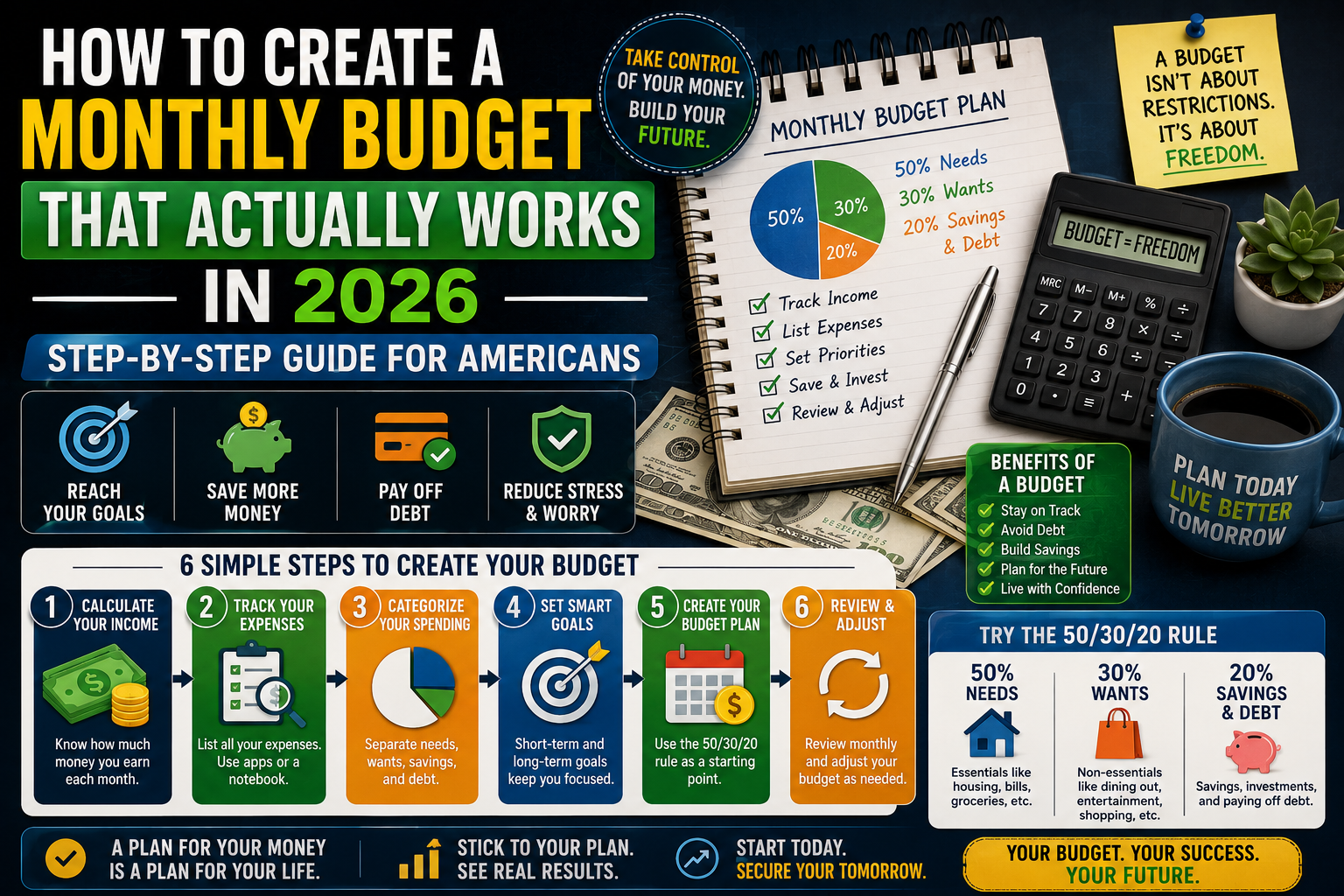
The 50/30/20 Rule (Best for Beginners)
This is the most widely recommended budgeting method in the country, and for good reason — it is simple, flexible, and effective. Here is how it works:
- 50% of your net income goes to needs: housing, groceries, utilities, transportation, insurance, and minimum debt payments.
- 30% of your net income goes to wants: dining out, entertainment, hobbies, streaming services, vacations, and non-essential shopping.
- 20% of your net income goes to savings and extra debt repayment: emergency fund, retirement contributions, paying down credit cards, and other financial goals.
Using the $3,900 example from Step 1:
- Needs: $1,950
- Wants: $1,170
- Savings & Debt: $780
The 50/30/20 rule works beautifully because it gives your money structure without micro-managing every dollar. If your needs currently eat up more than 50% — which is common in high-cost cities like New York, San Francisco, or Boston — adjust the percentages and trim the wants category accordingly.
Zero-Based Budgeting (Best for Detail-Oriented People)
With zero-based budgeting, every dollar of your income is assigned a specific purpose — until your income minus your planned spending equals zero. This does not mean you spend everything; it means every dollar has a job, whether that job is rent, groceries, savings, or debt repayment.
This method requires more effort than the 50/30/20 rule, but it gives you maximum control and visibility over your finances. It works especially well for households with variable expenses or those trying to aggressively pay off debt.
The Pay Yourself First Method (Best for Savers)
With this approach, the first “bill” you pay every month is to yourself. As soon as your paycheck arrives, a predetermined amount is automatically transferred to savings before you pay anything else. Then you live on whatever remains.
This method is psychologically powerful because it removes the temptation to save “whatever is left” — which for most people ends up being nothing. Research consistently shows that automating savings dramatically increases how much people actually set aside over time.
Step 4: Build Your Budget Category by Category
Now it is time to actually build the numbers. Using your chosen budgeting method as a guide, assign specific dollar amounts to each spending category. Here is a practical structure for a monthly budget:
Fixed Expenses (these stay the same every month):
- Rent or Mortgage: $_____
- Car Payment: $_____
- Insurance Premiums (health, auto, renters/homeowners): $_____
- Loan Minimum Payments: $_____
- Subscriptions (only the ones you are keeping): $_____
Variable Expenses (these change month to month):
- Groceries: $_____
- Gas / Transportation: $_____
- Utilities (estimate based on averages): $_____
- Dining Out / Food Delivery: $_____
- Entertainment: $_____
- Clothing / Personal Care: $_____
- Household Supplies: $_____
Savings and Financial Goals:
- Emergency Fund Contributions: $_____
- Retirement (401k, IRA): $_____
- Extra Debt Payments (above minimums): $_____
- Sinking Funds (see below): $_____
The Sinking Fund Strategy is one of the smartest budgeting moves you can make. A sinking fund is money you set aside each month for predictable but irregular expenses — things like annual car insurance payments, holiday gifts, back-to-school costs, and home repairs. Estimate the total yearly cost of these items, divide by 12, and move that amount into a dedicated savings account each month. When December rolls around and holiday shopping begins, you will have the money already sitting there — no stress, no credit card debt.
Step 5: Set Up Automation — Let Technology Do the Heavy Lifting
The biggest reason budgets fail is not lack of intention — it is lack of follow-through. Life gets busy, willpower runs out, and suddenly money that was supposed to go into savings gets spent on something else entirely.
The solution is automation. When you automate your budget, you remove the need for willpower entirely. Here is how to set it up:
Automate your savings first. Set up an automatic transfer to your savings account on the same day your paycheck deposits. Even a small amount — $50, $75, $100 — adds up to $600 to $1,200 per year without any effort on your part.
Automate your bill payments. Set all fixed bills — rent, utilities, insurance, loan payments — to auto-pay. This eliminates the risk of late fees and protects your credit score.
Use a budgeting app to track the rest. Apps like YNAB (You Need A Budget), Monarch Money, and PocketGuard connect to your bank accounts and credit cards, automatically categorize your spending, and show you in real time how much you have left in each budget category. These tools make staying on budget as simple as checking your phone for two minutes a day.
In 2026, the best high-yield savings accounts are paying between 4.5% and 5.2% annual percentage yield. This means every dollar you automate into savings is not just sitting there — it is quietly growing.
Step 6: Review, Adjust, and Repeat
A budget is not a contract written in stone. It is a living document that needs to be reviewed and adjusted regularly. Life changes — income goes up or down, expenses shift, new goals emerge — and your budget needs to change with it.
Weekly check-ins (10 minutes every Sunday): Compare what you planned to spend versus what you actually spent. Flag any categories where you went over. Ask yourself why, and decide if you need to adjust the category limit or your behavior going forward.
Monthly reviews (30 minutes at the end of each month): Look at the big picture. Did your total spending stay within your income? Did you hit your savings goal? Are there categories that consistently go over budget that need to be permanently adjusted?
Quarterly reviews: Step back and look at your progress toward larger financial goals. Is your emergency fund growing? Is your debt going down? Are your priorities still the same? This is also a good time to renegotiate bills, reassess subscriptions, and look for new opportunities to save.
One powerful mindset shift: stop treating an over-budget week as a failure. Every budget slips. The difference between people who succeed financially and those who quit is how they respond to imperfection. Treat a blown budget week like a missed workout — acknowledge it, understand what happened, and get right back on track. One bad week does not ruin a month. Quitting does.
The Best Free Budgeting Tools in 2026
You do not need expensive software to budget effectively. Here are the top free and low-cost tools available right now:
YNAB (You Need A Budget): The gold standard in budgeting apps. Uses the zero-based budgeting method. Excellent for people who want detailed control. Costs around $14/month but offers a free trial.
Monarch Money: A newer app gaining massive popularity for its clean interface and comprehensive financial tracking. Great for couples and families.
PocketGuard: Shows you exactly how much you have left to spend after bills, goals, and necessities. Perfect for people who want simplicity.
Google Sheets or Excel: Free, fully customizable, and powerful. Hundreds of free budget templates are available online. Best for people who prefer to do things manually.
Your bank’s app: Many modern banks and credit unions now have built-in budgeting and spending categorization tools. Check yours — you might already have everything you need.
Final Thoughts: Your Budget Is Your Path to Financial Freedom
Here is the truth that the most financially successful Americans already know: a monthly budget is not a punishment. It is not about restriction, deprivation, or saying no to everything you enjoy. A budget is simply a plan — a deliberate, intentional decision about what you do with the money you work hard to earn.
When you have a working budget, you stop wondering where your money went. You start making progress toward the things that actually matter to you — a home, a vacation, an emergency fund, a retirement where you do not have to work if you do not want to. That is what financial freedom actually looks like. And it starts with a single decision to take control of your money before it controls you.
Start today. Start small. Start imperfectly. Just start.
Your future self will thank you.
