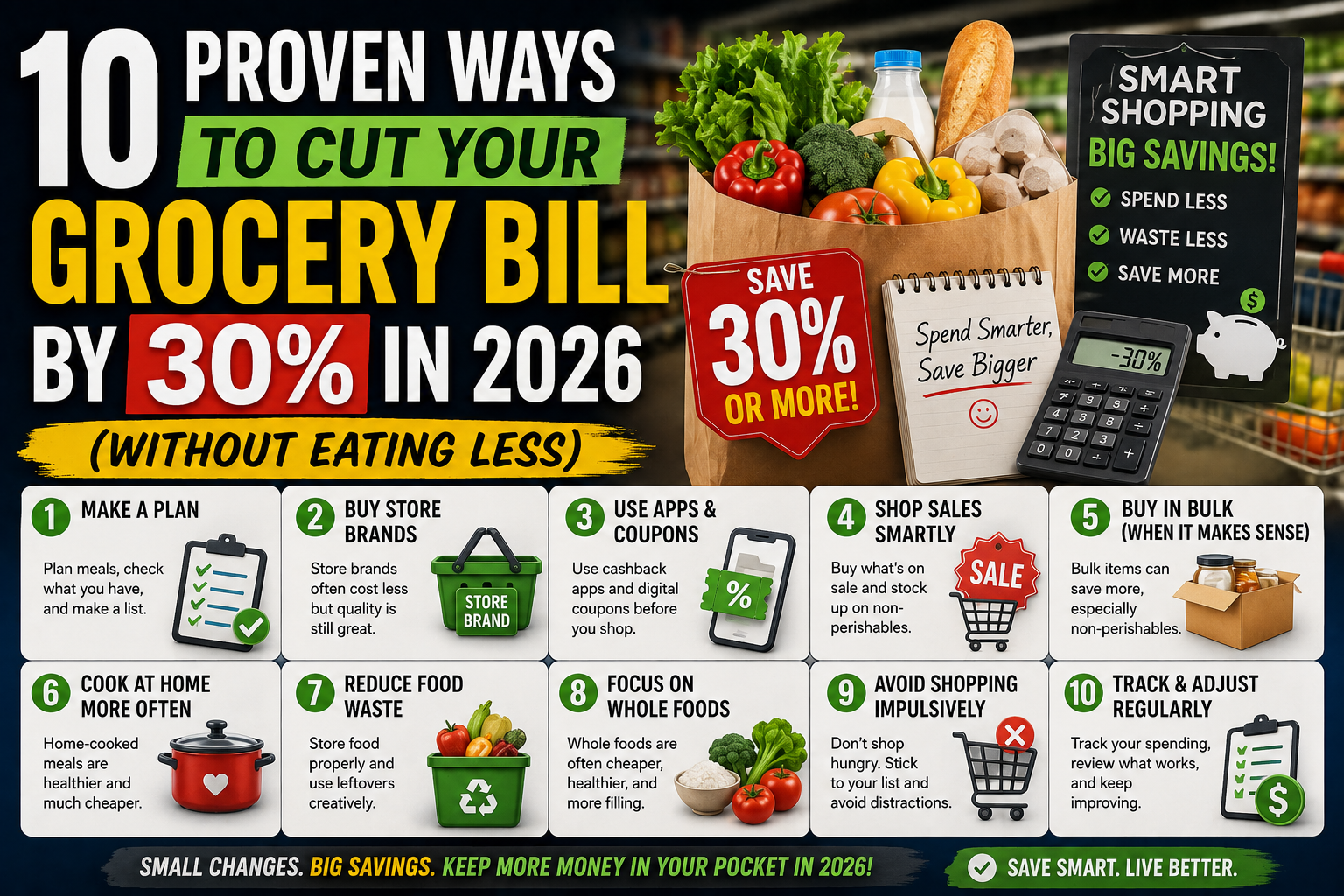
If it feels like every trip to the grocery store costs more than it did last year, you are absolutely right — and the numbers back you up. Food prices in America have climbed nearly 19% over the past four years, and in early 2026 alone, food inflation hit 3.1%. The result? The average American now spends around $438 per month on groceries. For a family of four, that number jumps to approximately $1,374 every single month — over $16,000 a year just to keep the refrigerator stocked.
That is a massive line item in any household budget. And for most families, it is also one of the most controllable expenses they have.
Unlike rent, car payments, or insurance premiums, your grocery bill is not fixed. It flexes based on how you shop, what you buy, and the habits you bring into the store with you. Which means that with a few smart adjustments, most American households can realistically cut their grocery spending by 25% to 30% — without eating less, without sacrificing nutrition, and without clipping coupons for hours every week.
This guide gives you 10 proven strategies to do exactly that. Let’s get into it.
Why Your Grocery Bill Is Higher Than It Should Be
Before we talk solutions, let’s talk about the real problem. Most people overspend at the grocery store not because of food prices — but because of habits. Here are the biggest culprits:
Shopping without a plan. Studies show that roughly 70% of grocery purchases are unplanned. When you walk into a store without a list or a meal plan, you are essentially walking into one of the most psychologically sophisticated retail environments ever designed — one specifically engineered to get you to buy things you did not intend to buy. The result is a cart full of impulse items that drive up your bill and often end up as waste.
Food waste is silent but expensive. The USDA estimates that 30% to 40% of the American food supply ends up as waste. Think about that for a moment — if you spend $600 per month on groceries and throw away a third of it, you are effectively flushing $200 down the drain every single month. Cutting food waste alone can save most households hundreds of dollars per year.
Convenience is costing you. Pre-cut fruit, marinated meats, single-serving packages, and pre-seasoned everything are all wildly more expensive per unit than their whole, unprocessed counterparts. You are paying for someone else’s time and labor every time you grab that bag of pre-shredded cheese or those pre-washed salad greens.
Brand loyalty is a marketing illusion. Name brands spend billions of dollars making you feel like their product is superior. In most cases, store-brand and name-brand versions of the same product are manufactured in the same facilities. The difference is the label — and a 25% to 40% markup on price.
Now let’s fix all of this.
Strategy 1: Meal Plan Before You Shop — Every Single Week
If there is one strategy on this list that delivers the biggest return for the least effort, it is meal planning. Research consistently shows that households that meal plan spend 15% to 20% less on food than those that shop without a plan. That translates to $65 to $120 in monthly savings for the average American household.
Here is how to make meal planning work in practice:
Before you write your grocery list, open your fridge, freezer, and pantry and take stock of what you already have. Write down what needs to be used soon. Then build your weekly meal plan around those items first, adding only what you genuinely need from the store.
Plan five to six dinners for the week. Lunches can usually come from leftovers. Breakfasts should be simple and repeat — oatmeal, eggs, yogurt, and fruit do not need to be reinvented every morning. This structure eliminates decision fatigue throughout the week and keeps impulse takeout orders at bay.
Once your plan is set, write your grocery list from the plan — not from memory, not in the store parking lot. This discipline alone will shrink your bill noticeably within the first two weeks.
Strategy 2: Switch to Store Brands for Staples
This is one of the fastest, easiest ways to save money at the grocery store — and one of the most dramatically underused.
Store-brand products typically cost 25% to 40% less than name-brand equivalents. And for pantry staples — pasta, rice, canned beans, canned tomatoes, flour, sugar, frozen vegetables, oats, cooking oils, and cleaning supplies — there is virtually no meaningful difference in quality. Most people cannot tell them apart in a blind taste test.
The math adds up quickly. If you spend $400 per month on groceries and swap just half of your name-brand purchases for store-brand alternatives, you could save $50 to $80 every single month. That is $600 to $960 per year from one simple habit shift.
Start by swapping five to ten items on your next grocery run — the ones you buy most frequently. Pasta, canned goods, frozen vegetables, and dairy products are excellent places to begin. Give the store brands a fair shot for a few weeks. Chances are, you will never go back.
Strategy 3: Use Grocery Pickup to Stop Impulse Buying
This strategy surprised many shoppers when they first tried it — but the data is impossible to argue with. Shoppers who switch to grocery pickup instead of in-store shopping report saving 15% to 20% on their bills almost immediately.
Why? Because the store cannot work its psychological magic on you if you are not walking its aisles. No end-cap displays strategically placed to catch your eye. No bakery smells pulling you toward the fresh pastries. No “oh, that looks good” moments in the chip aisle. You add exactly what is on your list, review your cart total before you submit the order, and pick it up at the curb.
Most major grocery chains — Walmart, Target, Kroger, Safeway, Publix — offer free grocery pickup. You order online or through the app, select a pickup window, and a store employee does the shopping and loads it into your car. It takes the same amount of time as driving to the store, requires no special membership, and systematically eliminates the impulse purchases that silently inflate your bill every week.
If you have not tried grocery pickup yet, this is the strategy to test first. Many people call it the single most impactful change they made to their grocery spending.
Strategy 4: Never Shop Hungry
This one sounds almost too simple — but the research behind it is real. Studies show that shopping on an empty stomach inflates your grocery bill by roughly 18% on average. When you are hungry, your brain makes food decisions based on immediate craving rather than planned need. Things end up in your cart that were never on your list and often never get fully eaten.
The fix is simple: eat before you shop. A small snack or a light meal before heading to the store is enough to put your decision-making back in rational mode. This one habit, practiced consistently, can save the average household $50 to $80 per month — just by having a banana before you walk out the door.
Strategy 5: Compare Unit Prices, Not Package Prices
Grocery stores are very good at making you think you are getting a deal when you are not. A “value size” package with a prominent discount sticker is not always the best value — and a smaller package sometimes costs less per unit than the jumbo version.
The only number that actually matters when comparing products is the price per unit — the cost per ounce, per pound, or per count. This is typically printed on the shelf tag in small numbers below the large package price. Train yourself to look at this number first and the total package price second.
This strategy becomes especially important in an era of “shrinkflation” — the widespread practice of reducing the amount of product in a package while keeping the price the same or even raising it slightly. A bag of chips that was 12 ounces last year might now be 10.5 ounces at the same price. Without checking unit pricing, you would never notice.
Strategy 6: Reduce Meat — Even by Just Two Meals a Week
Meat is consistently the most expensive line item in most American grocery carts. And you do not need to become vegetarian to take advantage of this — you just need to be strategic about it.
Replacing two meat-based dinners per week with plant-based alternatives — beans, lentils, eggs, canned chickpeas, or tofu — can save a typical household $40 to $60 per month. The protein content is comparable, the preparation time is often shorter, and the cost difference is dramatic.
Consider this: a pound of dried black beans costs around $1.50 and makes four to five full servings. A pound of ground beef costs $6 or more and covers maybe three servings. Once you see those numbers side by side, the math becomes hard to ignore.
Designate one or two nights per week as “plant-based nights” in your meal plan. Over time, this habit alone can save your household $500 to $700 per year — without sacrificing taste, nutrition, or satisfaction.
Strategy 7: Join Every Free Grocery Loyalty Program
If you regularly shop at Kroger, Safeway, Target, Publix, or any major grocery chain, sign up for their free loyalty program if you have not already. These programs are free to join and offer personalized coupons, point-based rewards, and weekly discounts that can meaningfully reduce your bill over time.
The key word here is strategic. Loyalty programs work in your favor when you use them to save on items you were already planning to buy. They work against you when they tempt you into buying things you did not need just because there is a deal attached to them. Use the discounts; resist the upsells.
Many loyalty apps also allow you to clip digital coupons before you shop. Spending five minutes browsing the app before your weekly shopping trip can easily save you $10 to $20 on a typical grocery run with zero additional effort at the checkout counter.
Strategy 8: Limit “Quick Runs” to the Store
One of the most expensive grocery habits most people do not realize they have is the mid-week “quick run.” You need one or two things, you pop in for five minutes — and you come out $30 to $40 later with things you did not plan to buy.
Research shows that each unplanned grocery store visit adds an average of $32 in unintended purchases. If you make two of these runs per week, that is over $250 per month in unnecessary spending.
The solution is to consolidate your shopping into one planned weekly trip. Build your meal plan, write your complete list, do one thorough shopping run, and commit to not going back until next week. If you run out of something mid-week, improvise with what you have — which is often more creative and satisfying than you expect.
This discipline alone can save $100 to $150 per month for households that currently shop multiple times per week.
Strategy 9: Eliminate Food Waste With a “Use It Up” System
As mentioned earlier, the average American household wastes 30% to 40% of the food it buys. Stopping that waste is essentially free money — it does not require cutting quality or eating less, just using what you already paid for.
Here is a simple system that works:
The front-of-fridge rule: When you put groceries away, move older items to the front of the fridge and place newer items behind them. This ensures you see — and use — the food that is closest to expiring before it goes bad.
The weekly “use it up” meal: Designate one night per week — Friday works well for many families — as a “use it up” night. Cook a meal built entirely around whatever is left in the fridge and pantry. A stir fry, a frittata, a grain bowl, or a soup can accommodate almost any combination of leftovers and nearly-expired ingredients. This single habit can save $50 to $100 per month by dramatically reducing what ends up in the trash.
Freeze everything you will not use in time. Bread, ripe bananas, leftover cooked grains, and most proteins freeze beautifully. Label containers with dates so you always know what is in the freezer and can plan meals around it.
Strategy 10: Cook in Batches and Embrace Leftovers
One of the biggest drivers of overspending on food is not the grocery store — it is the weeknight takeout order that happens because nobody wants to cook after a long day. The average American spends over $3,000 per year on restaurants and food delivery. Even reducing this by half saves $1,500 annually — that is $125 per month back in your pocket.
The most effective defense against weeknight takeout is having ready-made food already waiting for you at home. Batch cooking — preparing large quantities of staple items on Sunday that can be used in multiple meals throughout the week — makes this possible without requiring you to cook from scratch every evening.
Cook a large pot of rice or quinoa. Roast a sheet pan of vegetables. Cook a pound of chicken or a batch of lentils. These building blocks take an hour or two on Sunday and can be assembled into lunches and dinners all week with minimal daily effort.
When cooking dinner, double the recipe. One meal becomes tomorrow’s lunch. This approach, practiced consistently, not only cuts your grocery bill but also virtually eliminates the “I don’t feel like cooking” takeout orders that silently drain your food budget.
What Does a 30% Savings Actually Look Like?
Let’s put real numbers to all of this. If your household currently spends $600 per month on groceries:
- Switching to store brands on staples: saves $60 to $90/month
- Meal planning and reducing waste: saves $80 to $120/month
- Using grocery pickup instead of in-store: saves $90 to $120/month
- Cutting two meat dinners per week: saves $40 to $60/month
- Eliminating extra mid-week shopping trips: saves $60 to $100/month
Combined, these strategies can realistically save $200 to $300 per month — which is exactly that 30% to 50% reduction. And that money does not disappear. It goes directly toward your emergency fund, your debt payoff, or your savings goals.
The Bottom Line
Cutting your grocery bill is not about deprivation. It is not about eating boring food or spending your weekends clipping coupons from newspaper inserts. It is about shopping with intention — making deliberate choices about what you buy, how you shop, and how you use what comes home with you.
Food prices in America are higher than they have been in years. That reality is not going away anytime soon. But your response to that reality is entirely within your control. With the ten strategies in this guide, most American households can put hundreds of dollars per month back in their pockets — without changing what they eat, without sacrificing quality, and without making their lives more complicated.
Start with two or three strategies that feel most manageable. Build the habits. Add more over time. And watch your grocery bill — and your savings account — both move in the right direction.
